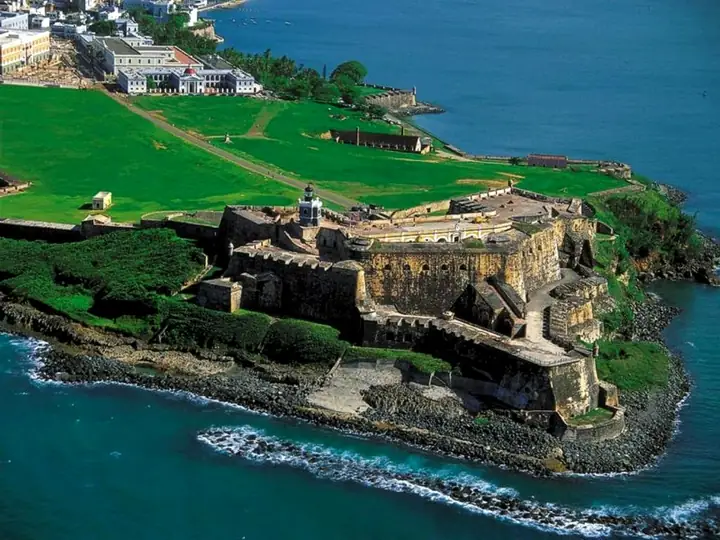
Castillo San Felipe del Morro, known simply as El Morro ("the headland"), sits on the northwestern tip of Old San Juan, where the Atlantic meets the mouth of San Juan Bay. For more than three centuries it was the first thing an enemy fleet had to get past to reach the city. Today it is managed by the National Park Service as part of San Juan National Historic Site, and together with the rest of the city's fortifications and La Fortaleza it was named a UNESCO World Heritage Site in 1983.
A short history
Spain began building the fort in 1539, starting with a small tower and gun battery at the bay entrance. Over the next 250 years it grew into the six-level, stair-stepped citadel you see now, largely finished around 1790. Its job was to control who entered the harbor.
El Morro was tested repeatedly. In 1595 Sir Francis Drake attacked from the sea and failed. In 1598 George Clifford, the Earl of Cumberland, landed east of the city and came at the fort from the land side; the English held it briefly before disease forced them out. In 1625 a Dutch force besieged the city for 21 days, failed to take El Morro, and burned much of San Juan before leaving. Those attacks drove the construction of the city walls and of Castillo San Cristóbal to guard the landward approach.
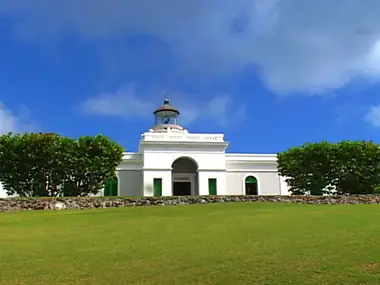
The fort's last combat came in 1898, during the Spanish-American War, when U.S. Navy ships shelled San Juan and, as the Park Service puts it, enemy fire reached El Morro for the first time in more than 400 years. Under U.S. control the site became part of an Army post. The lighthouse on the upper level dates from 1908, replacing earlier towers going back to 1846 (one of which was knocked out of service in the 1898 bombardment). During World War II the Army added a concrete bunker, a naval observation post and an anti-aircraft emplacement to watch for submarines and aircraft. San Juan National Historic Site was established in 1949, and El Morro was the first part of it the Park Service operated.
What you see inside
You arrive across the esplanade, the wide lawn that once served as an open field of fire. Today it is where San Juan families picnic and fly kites (chiringas), especially on breezy weekend afternoons.
Inside, the main plaza on the fifth level holds the visitor exhibits, a bookstore and a theater showing an introductory film with captions in English and Spanish. From there, ramps and stairs lead down toward the water and up to the gun decks. Highlights:
- The ramparts and cannon batteries, with long views over the Atlantic and across the bay.
- The garitas, the domed stone sentry boxes that have become a symbol of Puerto Rico. Step inside one and look out through the slit.
- Barracks and storerooms from daily garrison life.
- The lighthouse and the World War II structures on the top level.
- El Cañuelo (Fortín San Juan de la Cruz), the small fort across the channel on Isla de Cabras. Its guns and El Morro's created a crossfire at the harbor mouth.
Park rangers give interpretive talks during the day, and kids can pick up a Junior Ranger booklet.
Fees and hours
The entrance fee, per the Park Service, is $10 for visitors 16 and older and covers both El Morro and San Cristóbal for 24 hours. Children 15 and under enter free. America the Beautiful passes are accepted, and the park sells its own annual pass. The forts do not accept cash; bring a card or a phone with contactless payment.
The forts open daily at 9 a.m. and close in the late afternoon (reported as 5 p.m. in early 2026). They are closed on Thanksgiving, Christmas and New Year's Day. Hours and fee-free days do change, so check the NPS fees and hours pages before you go. During the Fiestas de la Calle San Sebastián in January, the Park Service has closed the El Morro grounds overnight to protect the site from crowd damage.
Getting there
El Morro is at the end of Calle Norzagaray in the northwest corner of Old San Juan. There is no parking at the fort itself. Drivers usually leave the car in one of Old San Juan's public garages and walk; the old city's streets are narrow, steep and congested, especially on weekends and cruise days. Taxis and rideshare cars can drop you near the esplanade, and it is a five-minute walk across the grounds to the entrance.
From the cruise piers on the south side of the old city, most visitors walk; allow 15 to 25 minutes, much of it uphill. The Park Service estimates 20 to 30 minutes by car from Luis Muñoz Marín Airport, traffic permitting.
Practical tips
- Go early. The esplanade and gun decks have almost no shade. The first hour after opening is cooler and quieter, before cruise-ship groups arrive.
- Allow two hours for the fort itself, more if you want to sit on the walls or catch a ranger talk.
- Bring water, a hat and sunscreen, and wear shoes with grip: the stone ramps are steep and can be slick after rain.
- Accessibility: the approach sidewalk is level, and the fifth-level plaza with exhibits, bookstore and theater is accessible. The sixth level is reached by steep ramps, and the lower levels are not wheelchair accessible. Call the park ahead of time to arrange accommodations.
- Drones are not permitted in national park units without a special permit.
Combine it with
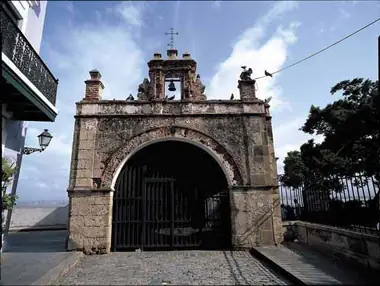
Your ticket is good at Castillo San Cristóbal the same day, about a 20-minute walk east along Calle Norzagaray. The restored San José Church is a few minutes downhill. From there it is a short walk down Calle del Cristo to the Cathedral of San Juan Bautista, the Capilla del Cristo and Parque de las Palomas. The waterfront path below the walls, the Paseo del Morro, links the area to the San Juan Gate, but parts of it have been closed in 2026 for a U.S. Army Corps of Engineers wall restoration project, so check its status with the park.
Good to know
- One $10 ticket (ages 16+) covers both forts for 24 hours; card or contactless only.
- Closed Thanksgiving, Christmas and New Year's Day.
- No parking at the fort; use an Old San Juan garage, a taxi or rideshare.
- Stay for late afternoon on the esplanade, when the kites are up. See also our top things to do in Puerto Rico.