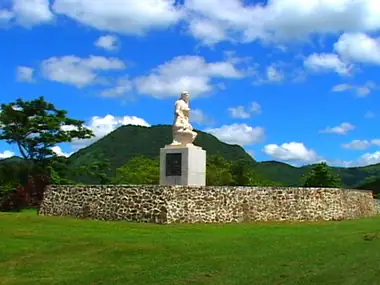
Drive the PR-52 expressway between San Juan and Ponce and, as the road crests the mountains above Salinas, you pass a large sculpture on a hillside: a farmer and his family. This is the Monumento al Jíbaro Puertorriqueño, the island's tribute to the jíbaro, the rural mountain farmer who became a symbol of Puerto Rican identity. It is not a destination in itself, but it is a worthwhile 15- to 20-minute break on the island's main north-south route, with a wide mountain view, and a good way to understand an idea that runs deep in the island's culture.
Who the jíbaro is
In Puerto Rico, jíbaro refers to the traditional farmers of the mountainous interior. Many grew just enough to feed their families, while others worked as tenants, sharecroppers or laborers and sold surplus crops in town. The jíbaro is associated with hard work, family, hospitality and resourcefulness, and with a country music built around the cuatro, the guitar and the güiro.
In the mid-20th century, the jíbaro moved to the center of the island's politics. Luis Muñoz Marín built his populist campaigns around the countryman and made the profile of a farmer in a straw pava hat the emblem of his party. At the same time, the industrialization program known as Operation Bootstrap drew many families out of the mountains and into the cities. Today the word is mostly a proud one, though it can still be used to tease someone as unsophisticated.
The monument
The Government of Puerto Rico commissioned the monument to honor the island's countrymen. Work began around 1973, and it was unveiled on December 12, 1976, with a message from Governor Rafael Hernández Colón. The sculpture, a stucco group on a pedestal, depicts the humble, hard-working farmer together with his family.
The sculptor, Tomás Batista, was born in Luquillo in 1935. He trained at the Instituto de Cultura Puertorriqueña and in Mexico City, and in 1966 became head of the institute's department of sculpture and restoration. His other public works include statues of the poet Julia de Burgos in Carolina, the Taíno figure Hayuya in Jayuya, and the composer Rafael Hernández in Bayamón, as well as a monument to the cacique Loquillo in his hometown.
Where it is, exactly
Almost everyone calls it the Jíbaro monument "in Cayey," but it actually stands in Barrio Lapa, in the municipality of Salinas, at about kilometer 49 of PR-52, between Cayey and Salinas. The site sits where the green, humid mountain interior gives way to the dry south. On the drive you will notice the change: lush forest on the north side of the range, dry scrub and cactus on the south.
Getting there
- Southbound only. The monument's pull-off is reached from the southbound lanes of PR-52, heading from Cayey toward Salinas and Ponce. There is no access from the northbound side, so if you are driving north toward San Juan, plan to stop on your southbound trip instead.
- Parking. There is a parking area beside the monument, from which you walk up to the statue.
- Facilities. It is called a rest area, but there are no restrooms, food, fuel or other services. Use the facilities in Cayey or Salinas.
- Road works. A major landslide in November 2022 damaged this stretch of PR-52, and the highway authority (ACT) has been rebuilding it since. On March 30, 2026, it opened two more lanes in front of the monument, but stabilization of the slopes was still underway. Expect work zones, lane shifts and lower speeds, and check whether the pull-off is open before counting on the stop.
The view: Las Tetas de Cayey
Look to the northwest from the parking area and you will see two rounded peaks side by side, Las Tetas de Cayey. The name, which is colloquial Spanish for breasts, comes from their shape. Despite the name, they also lie in Salinas, in Barrio Palmas, though they are reached by a road from Cayey. The peaks rise to about 842 meters (2,762 feet), with the western one slightly higher, and they have been protected as part of the Reserva Natural Las Piedras del Collado since 2000. Hiking and climbing on the peaks are usually arranged through local tour operators.
Practical tips
- Daylight is best. There are no staff or services on site. Stop during the day and keep valuables out of sight.
- Merge with care. Traffic on PR-52 moves fast, and work zones can change the entry and exit points. Slow down well before the pull-off and use your turn signal early.
- Bring water and a hat, since nothing is sold at the stop.
- How long. Fifteen to twenty minutes is enough for photos and the view.
Combine it with
The monument fits into any drive between San Juan and the south coast. Just north, in Cayey, the lechoneras of Guavate serve slow-roasted pork, especially lively on weekends, and the Cayey directory lists other places to eat. Continuing toward Ponce on PR-52, you can detour to the Coamo thermal baths and then carry on to Ponce, where the historic center around Plaza Las Delicias is worth a full day. For mountain adventure, head into the Cordillera to Toro Negro State Forest.
Good to know
- Where: PR-52 at about km 49, Barrio Lapa, Salinas, near Cayey.
- Access: southbound lanes only. Parking but no facilities.
- Sculptor: Tomás Batista. Unveiled December 12, 1976.
- Highway rehabilitation after a 2022 landslide was still in progress in 2026.
- View: Las Tetas de Cayey, two peaks to the northwest.