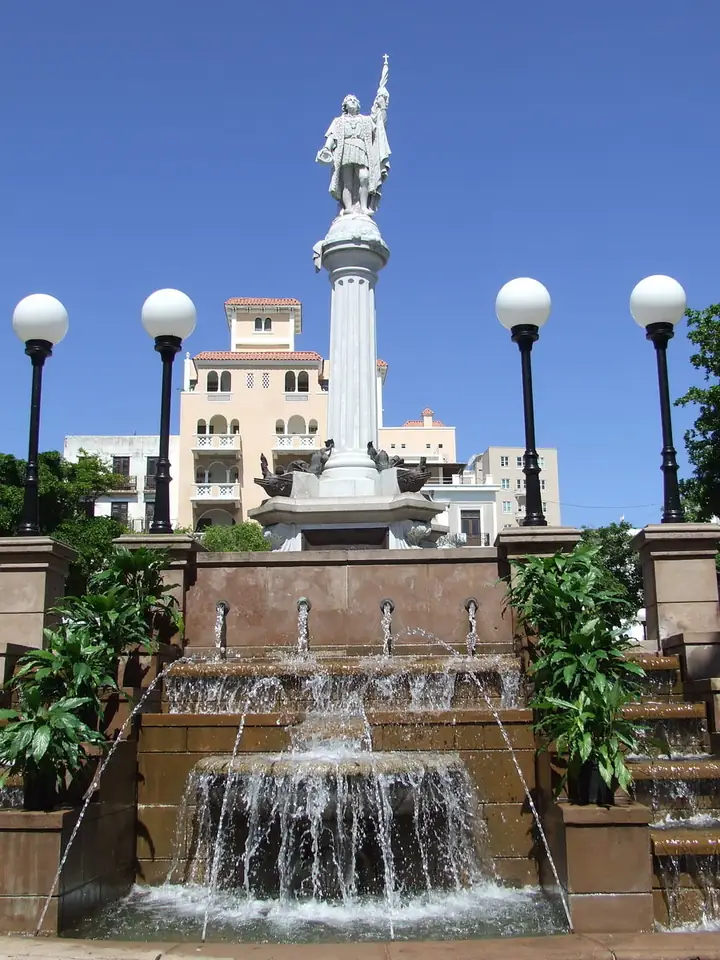
Plaza Colón sits at the eastern edge of Old San Juan, where the walled city meets the modern one. A tall column topped by a statue of Christopher Columbus rises from the middle of a marble-paved square ringed with ornate lamp posts, cafés and some of the old city's grandest 19th-century buildings. Most visitors pass through it without stopping, on the way to Castillo San Cristóbal or the cruise piers, but it rewards a closer look. This is the spot where, for more than two centuries, the only road into San Juan passed through the city wall.
From city gate to public square
San Juan was a walled city. The plaza occupies the site of the easternmost section of those walls and of the Puerta de Santiago, the Santiago Gate, also called the Land Gate. Of the city's five gates it was the one that mattered most on land, because it stood on the only road linking San Juan with the rest of the island. Anyone arriving by land, from merchants to soldiers, came through here.
The open ground next to the gate slowly took shape as a square. By 1772 it already had the outline of what was then called the Plaza de Santiago, though it was not paved. Between 1862 and 1870 the square was refurbished and began to look much as it does now. The biggest change came in 1897, when this section of the wall was demolished. By then the walls were seen as militarily unnecessary and as an obstacle to growth, cutting the old city off from the new districts expanding to the east. With the gate gone, the plaza became the hinge between the two.
The Columbus statue
The statue went up in 1893 to mark the 400th anniversary of Columbus's arrival in Puerto Rico, which happened in 1493 during his second voyage. Once it was in place, people began calling the square Plaza Colón, and the old name faded. A statue of Juan Ponce de León, the island's first Spanish governor, had previously stood in the center of the square; it was moved to Plaza San José, beside the San José Church, where it still stands.
The figure on top of the column is a reminder that the story of 1493 is told differently today. Puerto Rico was home to the Taíno people long before the Spanish arrived, and their population collapsed under colonial rule. Many Puerto Ricans see the monument with that history in mind.
The marble paving and the decorative lamp posts were added during the revitalization of Old San Juan in the second half of the 20th century. The plaza is a contributing property of the Old San Juan Historic District, which has been on the U.S. National Register of Historic Places since 1972 and became a National Historic Landmark District in 2013.
What's around the square
- Teatro Tapia, on the south side along Calle Fortaleza, is the oldest free-standing theater building in San Juan. It opened in 1832 and still hosts plays, concerts and comedy.
- The Antiguo Casino de Puerto Rico, another of the landmark buildings that frame this edge of the old city.
- Calle Fortaleza starts here and runs west into the heart of the old city, with restaurants and cafés, some with tables looking onto the plaza.
- Castillo San Cristóbal, the great fort guarding the city's land side, is a few minutes' walk uphill to the north.
- El Capitolio, Puerto Rico's Capitol, lies a short walk east along Avenida Ponce de León.
Events
Plaza Colón is one of Old San Juan's main gathering points. During the Fiestas de la Calle San Sebastián each January, it is one of the plazas that hosts a stage, and it is packed with people. The rest of the year it is a common meeting place and a starting point for walking tours of the old city.
Getting there
The plaza is at the eastern end of Calle Fortaleza, where the old city meets the avenues that lead out toward Puerta de Tierra. It is close to the main cruise ship docks, so many passengers start their visit here. Public buses run to the Covadonga terminal on the south side of Old San Juan, a short walk away. If you are driving, use one of the public parking garages in Old San Juan rather than hunting for street parking, which is scarce.
Practical tips
- How long: 10 to 15 minutes for the square itself; it works best as the first or last stop of a walk through the old city.
- Sun: midday sun on the open marble is strong; the cafés along Calle Fortaleza are the easiest place to sit in the shade.
- Orientation: from here, Calle Fortaleza leads west toward La Fortaleza; uphill to the north is San Cristóbal.
- Tours: if you would rather have a guide, several Old San Juan walking tours, including the Old San Juan Free Walking Tour, cover this part of the city.
Combine it with
A natural route starts at Plaza Colón, climbs to Castillo San Cristóbal, then follows Calle Fortaleza west to La Fortaleza and down to the Paseo de la Princesa along the bay. If you have tickets for an evening show at Teatro Tapia, have dinner on Calle Fortaleza first; the theater is across the square.
Good to know
- The square stands on the site of the Santiago Gate and the eastern city wall, demolished in 1897.
- The Columbus statue dates from 1893, the 400th anniversary of his arrival in 1493.
- Teatro Tapia is on the south side of the square.
- Free and open at all times. It works as a starting point for exploring Old San Juan on foot.