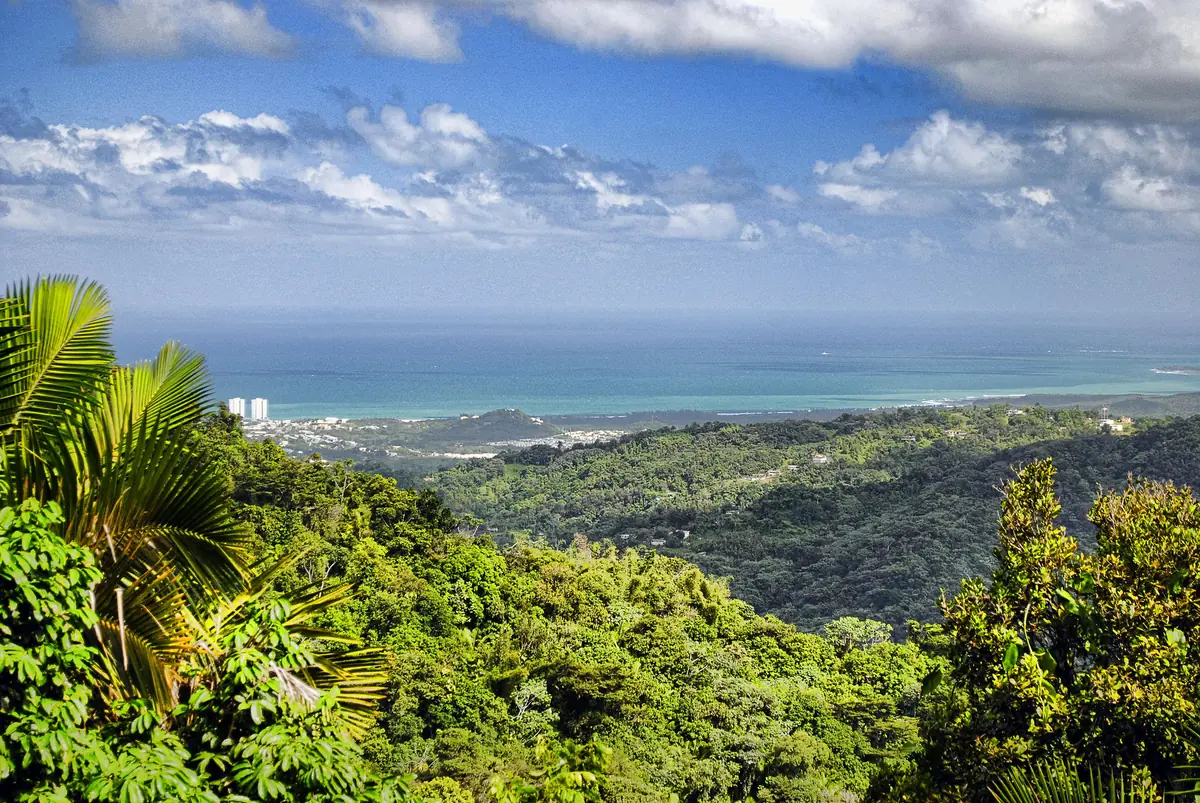
High on El Vigía hill above Ponce, Castillo Serrallés is the house that sugar and rum built. The Serrallés family, whose distillery produces Don Q rum, commissioned this Spanish Revival mansion in the 1930s, at the height of their wealth and influence in southern Puerto Rico. Today it is a house museum, furnished much as it would have been in the family's heyday and surrounded by terraced gardens with sweeping views over the city and the Caribbean. It's one of the most rewarding stops in Ponce and an easy pairing with the cross and gardens next door.
The family and the house
In the nineteenth and early twentieth centuries, the land around Ponce was planted in sugar cane, and a handful of families grew rich processing it. The Serrallés family ran the Hacienda Mercedita sugar operation and, from it, a rum distillery that became one of Puerto Rico's best-known producers. The mansion was built for Juan Eugenio Serrallés, son of the distillery's founder, and designed by the Ponce architect Pedro Adolfo de Castro y Besosa.
De Castro worked in the Spanish Revival style, and the house shows it: red tile roofs, pale stucco walls, wrought iron, carved wood and Moorish-influenced details. It was also technically advanced for its era, and guides like to point out features that made the household run smoothly. The house reflects a moment when Ponce's elite looked to Europe and Spain for their cultural models, and when the south of the island rivaled San Juan in wealth.
The family eventually sold the house. The Municipality of Ponce bought it from the heirs, restored it and opened it as a museum in 1991. The city still owns it, and it is managed by the Patronato del Castillo Serrallés, a nonprofit organization.
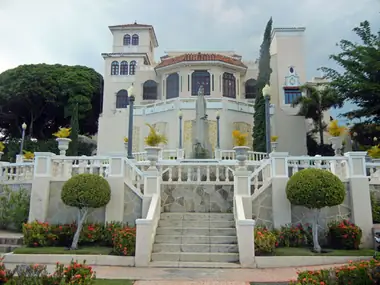
What you'll see
Visits to the house are by guided tour, offered in Spanish and English. The tour moves through the main rooms of the house, with period furnishings, family photographs and decorative pieces. Guides tell the story of the family, the sugar economy and rum making, which gives you a good sense of how much of Ponce's history ran through this industry.
Outside, the formal gardens step down the hillside with fountains, clipped shrubs, terraces and views across the city to the sea. The broader complex on El Vigía hill also includes a butterfly garden (mariposario) and a Japanese garden, and the museum offers rum experiences linked to Don Q. Check the museum's website for which experiences are running and how tickets are bundled; combination tickets have often covered several of the hilltop attractions.
Hours and tickets
At the time of writing, the museum's official website lists opening hours from Thursday through Monday, during the daytime, and it is closed on Tuesdays and Wednesdays. Schedules have shifted over the years and third-party listings are often out of date, so confirm days, tour times and current admission prices on the museum's website or by phone before you go. Groups should reserve in advance.
Getting there
Castillo Serrallés is about two miles north of Ponce's main square, Plaza Las Delicias. From downtown, follow the signs up to El Vigía; the road climbs steeply and winds through a residential neighborhood. There is parking at the museum. Ponce is roughly an hour and a half by car from San Juan via the PR-52 toll road, and the city's Mercedita airport has limited flights. Taxis and ride services in Ponce can take you up the hill if you'd rather not drive the narrow streets.
Practical tips
- Allow about two hours for the house tour and gardens, more if you add the cross and Japanese garden.
- Go in the morning for cooler temperatures in the gardens and clearer views.
- Wear comfortable shoes. The gardens involve stairs and slopes.
- Accessibility: the hillside site and the historic house have steps; ask the museum in advance about which areas are accessible.
- Photography: ask your guide about rules inside the house.
Combine it with
Right beside the mansion stands the Cruceta del Vigía, a 100-foot cross-shaped observation tower on the site where lookouts once watched for ships approaching Ponce's harbor. Read more in our guide to El Vigía. Back downtown, spend an afternoon around Plaza Las Delicias, with the red-and-black Parque de Bombas and the Ponce Cathedral. In the evening, head to the waterfront boardwalk at La Guancha. For deeper history, the pre-Columbian site at Tibes is a short drive north of the city. Note that the Museo de Arte de Ponce is closed for reconstruction.
Good to know
- Owned by the Municipality of Ponce and run as a museum by the nonprofit Patronato del Castillo Serrallés.
- Visits are by guided tour in Spanish or English.
- The official site lists Thursday-to-Monday hours; confirm before you go.
- Expect hills and stairs on the grounds.
- Pair it with the Cruceta del Vigía and the Japanese garden on the same hill.