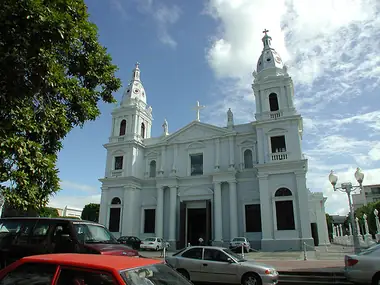
Every Puerto Rican town has a central plaza, and Ponce's is one of the most elaborate. Plaza Las Delicias, at the heart of the city's historic center, is actually two squares in one, split down the middle by the Cathedral of Our Lady of Guadalupe and the striped red-and-black firehouse behind it. Around the edges stand City Hall, grand old bank buildings and a 19th-century mansion. In between are shade trees, benches, bronze statues and the famous Lion Fountain. It is the place to start any visit to Ponce, and with a stroll, a look inside the landmarks and an ice cream, you can easily spend half a day here.
How the plaza is laid out
Following the Spanish colonial pattern, the main church sits in the middle of the square. Here, the cathedral and the Parque de Bombas stand in the center and divide the plaza into two parts:
- Plaza Federico Degetau, the larger southern square, originally called the Plaza Real. It faces City Hall and holds the Lion Fountain.
- Plaza Luis Muñoz Rivera, the smaller northern square, once known as the Paseo de la Alameda.
Both are named for Puerto Rican political leaders of the late 19th and early 20th centuries.
A little history
The plaza's story begins around 1670, when the first settlers built a small chapel on the spot where the cathedral now stands. Ponce was officially recognized as a town in 1692, and its square grew around the church. Around 1840, Mayor Salvador de Vives had trees planted as part of a renovation. In 1864 the plaza was lit for the first time. In 1914 the Ponce architect Francisco Porrata-Doria, who later redesigned the cathedral, laid out the Degetau square.
What to see in the plaza
The Lion Fountain
The Fuente de los Leones, in Plaza Degetau, is the plaza's postcard image. Its marble and bronze basin, set inside an octagonal wall and guarded by four lions, was bought at the 1939 New York World's Fair. The lion is a symbol of Ponce and appears on its coat of arms. The fountain was restored in 1993, when its base was enlarged and colored lighting was added. Come back after dark to see it lit up.
Statues and monuments
- Luis Muñoz Rivera: a bronze statue of the autonomist leader, unveiled in 1923 and cast in Pietrasanta, Italy, at the workshop of sculptor Luiggi Tomassi.
- Juan Morel Campos: the Ponce composer, master of the danza, also by Tomassi's workshop, in Plaza Degetau.
- The firefighters' obelisk: a memorial to the firemen who fought the El Polvorín fire, honored in Ponce as heroes.
Parque de Bombas
The red-and-black striped wooden firehouse behind the cathedral is the most photographed building in Ponce. Built as the main pavilion of an 1882 trade fair, it became a fire station in 1883 and served firefighters until 1990. It is now a small firefighting museum. See the full Parque de Bombas guide for its history and visiting details.
The Cathedral of Our Lady of Guadalupe
The Catedral Nuestra Señora de Guadalupe is the seat of the Roman Catholic Diocese of Ponce and the spiritual center of the city. The Virgin of Guadalupe is Ponce's patron saint.
History
The church on this site has been rebuilt several times. The first chapel of about 1670, made of wood and straw, became a parish church in 1692. A larger church went up in the 1830s and was completed in 1839. Fires and earthquakes damaged it repeatedly, and the San Fermín earthquake of 1918 badly cracked its towers and facade. Pope Pius XI created the Diocese of Ponce in 1924, turning the church into a cathedral. Porrata-Doria then led its reconstruction in reinforced concrete over the following years, giving it a new roof, new chapels, a remodeled upper facade and two new square towers. The finished building was dedicated on April 11, 1950. It was added to the U.S. National Register of Historic Places in 1984.
What to look for
- The facade. Neoclassical, painted in pale blue and gray, with a triangular pediment and two three-story towers capped by silver domes and crosses.
- The interior. A cross-shaped plan with a dome over the crossing, a vaulted nave and many stained glass windows with religious scenes.
- The main altar. Made of alabaster in Burgos, Spain, and donated by the Ferré family. The earlier Gothic-style wooden altar now stands in a side chapel.
- The pipe organ. Installed in 1934 in the choir loft above the entrance. It was put back in service in 1989 after a restoration that took nine years.
Las Mañanitas
The cathedral's big day is December 12, the feast of the Virgin of Guadalupe. Since 1965, Ponce has celebrated Las Mañanitas: a procession before dawn that ends at the cathedral for a 5 a.m. Mass, drawing thousands of people to the plaza.
Earthquake damage and visiting today
The earthquakes of January 2020 hit the cathedral hard. The pastor reported serious cracks, especially in the chapel of the Blessed Sacrament, a cracked tower cupola, and pieces coming loose from the roof, the main dome and the arches over the stained glass windows. The building was closed for a time, and some damage was still visible in 2025. Access to the interior may be limited, and Mass schedules can change, so check with the Diocese of Ponce before you plan to go inside. If you visit during a service, be quiet and dress respectfully. Even from outside, the facade and towers are worth seeing.
Around the edges
Take a slow lap around the plaza to see the buildings that frame it. City Hall, the Casa Alcaldía, faces the Degetau square. On the east side are two historic bank buildings, the Banco Crédito y Ahorro Ponceño and the Banco de Ponce, both listed on the National Register. To the west is the Casa Armstrong-Poventud, a historic family residence. The Teatro Fox Delicias stands just north of the Muñoz Rivera square, and the Paseo Atocha street and the King's Cream ice cream parlor are close by.
When to go and events
Mornings are quieter and cooler for photos. Evenings are livelier, with families out, the fountain lit, and often a band playing. The plaza is the stage for Ponce's major celebrations, including the Carnaval Ponceño before Lent, the city's Fiestas Patronales and Las Mañanitas in December.
Getting there and parking
Plaza Las Delicias is in the center of the Ponce Historic Zone. Park in one of the lots or garages around the historic center and explore on foot, since most downtown sights are within a few blocks.
Combine it with
From the plaza, it is a short walk or drive to the Museo de la Música Puertorriqueña and the Museo de Arte de Ponce. Drive up the hill to the observation cross at El Vigía for a view over the plaza and the coast, and end the day by the sea at La Guancha.