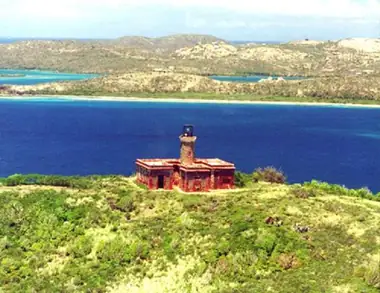
Culebrita is a small, uninhabited island off the east coast of Culebra, roughly a mile long and a little less than a mile wide. It has no roads, no stores and no residents, just dry scrub, half a dozen beaches, tidal pools and, on its highest hill, the shell of a Spanish lighthouse completed in 1886. The whole island is part of the Culebra National Wildlife Refuge. A boat ride of about 20 minutes from Culebra gets you there, and for many visitors it is the highlight of a trip to the Spanish Virgin Islands.
The lighthouse: history and condition
The Spanish Crown began building the Culebrita lighthouse in September 1882 and finished it in February 1886. Part of the purpose was political: a staffed light on the archipelago helped Spain assert its claim to Culebra and the surrounding waters. The construction was hard work on an empty island. Crews built a wooden pier, cut a road by hand to the summit and used donkeys to haul materials. The result was a T-shaped stone building with a 37-foot tower and two identical keepers' apartments. The light stood about 305 feet above the sea and guided ships through the Virgin Passage and Vieques Sound, working with the light at Cabezas de San Juan in Fajardo.
After the Spanish-American War of 1898 the lighthouse passed to the United States. The Navy used it as an observation post in the late 1960s, and it was destaffed for the last time in 1975. The Coast Guard replaced it with a solar-powered beacon. The building was added to the National Register of Historic Places in 1981, and in 2002 the federal government transferred it and about four surrounding acres to the Municipality of Culebra.
Since then, the building has suffered badly. Hurricanes Hugo (1989) and Marilyn (1995) caused major damage, Marilyn tore off the cupola, and vandalism has done the rest. Doors, windows and part of the roof are gone. The Culebra Foundation has campaigned to save it since 1994, and in 2015 Para la Naturaleza announced plans to work with the municipality on its restoration, but no restoration has been reported since, and the structure is described as at risk of collapse. The building is closed and you should not go inside or climb the deteriorated metal stairs. The grounds around it still offer sweeping views over Culebra, the surrounding cays and the open sea.
The beaches and the "baths"
- Playa Tortuga (Turtle Beach). The island's main beach is a white-sand cove on the north side, named for the sea turtles that nest there and graze in the bay. Green turtles are often seen while snorkeling. It is also where boats crowd the moorings on summer weekends.
- The tidal pools. On the north and east sides, rock formations break the incoming waves and create natural pools, sometimes called the "baths" or "jacuzzis," where people lounge in the churning water. At low tide they trap small sea creatures. Only go in when the sea is calm, because big northern swells can wash right over them. Ask your boat captain to point out the way.
- West and southwest beaches. Many water taxis drop passengers on the southwest side, where the water is usually calm and the reef offshore offers decent snorkeling.
- Trash Beach. On the windward side, this beach collects debris carried in by the currents, which explains the name.
Hiking to the lighthouse
From the beach on the south side, a trail runs inland to a fork. One branch leads to Playa Tortuga and the other climbs to the lighthouse; each takes about 20 minutes. The climb is steep, exposed and hot, so start early, carry water and wear real shoes rather than flip-flops. The Fish and Wildlife Service maintains an official trail on the island, and unofficial paths also exist; stick to marked trails. Goats live wild on the island, so you may see signs of them.
Getting there
First you need to reach Culebra, by ferry from Ceiba on the main island or by small plane; see our Culebra guide. From Culebra, you have two main options:
- Water taxi. Several small operators run boats from Culebra, dropping you on the southwest side or at Playa Tortuga and collecting you at an agreed time and place. Prices depend on group size and season. H2O Water Taxi is one operator that lists Culebrita trips. Confirm the pickup time and spot before the boat leaves.
- Kayak, snorkel or sailing tours. Guided trips from Culebra combine Culebrita with snorkeling stops; see KPR Culebra Aquafari, for example. Some day trips from Fajardo also stop at the island.
The refuge's public areas and trails are open daily from 6:00 a.m. to 6:00 p.m., as of 2026. Contact the refuge for current rules before you go.
What to bring and safety
Culebrita has no facilities of any kind: no water, no shade structures, no restrooms, no food and no lifeguards. Pack everything you need for the day and carry all trash back out.
- Plenty of drinking water, food and snacks.
- Sunscreen, a hat, insect repellent and a towel.
- Snorkel gear.
- Strap-on water shoes that can handle trails, rocks and the pools.
Watch the sea carefully. The north side gets large waves, and there is no rescue support on the island, so stay out of the pools and away from rocky edges when the swell is up. Give nesting turtles and their marked nests plenty of room, and do not feed or chase wildlife.
Combine it with
From the far east end of Culebra, Zoni Beach looks straight across to Culebrita, and it makes a good quiet afternoon on land after a morning on the island. Back on the main island, Flamenco Beach is Culebra's best-known stretch of sand.
Good to know
- Uninhabited island in the Culebra National Wildlife Refuge, about 20 minutes by boat from Culebra.
- Lighthouse completed 1886, decommissioned 1975, now a ruin: admire it from outside only.
- Playa Tortuga is the main beach; tidal pools on the north side are for calm days only.
- No facilities, no water and no lifeguards. Bring everything.
- Refuge areas open 6 a.m. to 6 p.m. as of 2026.