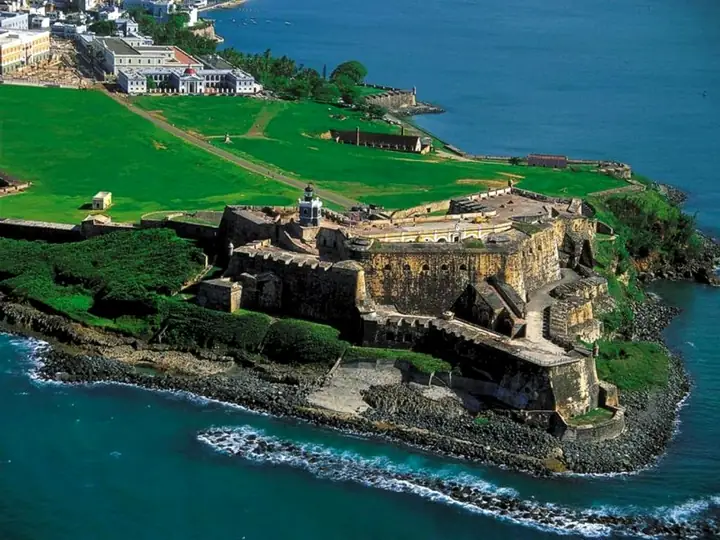
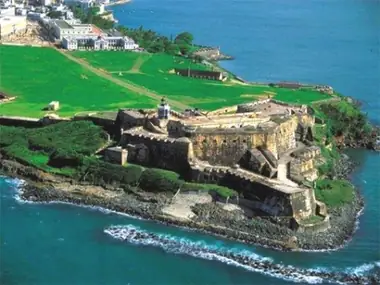
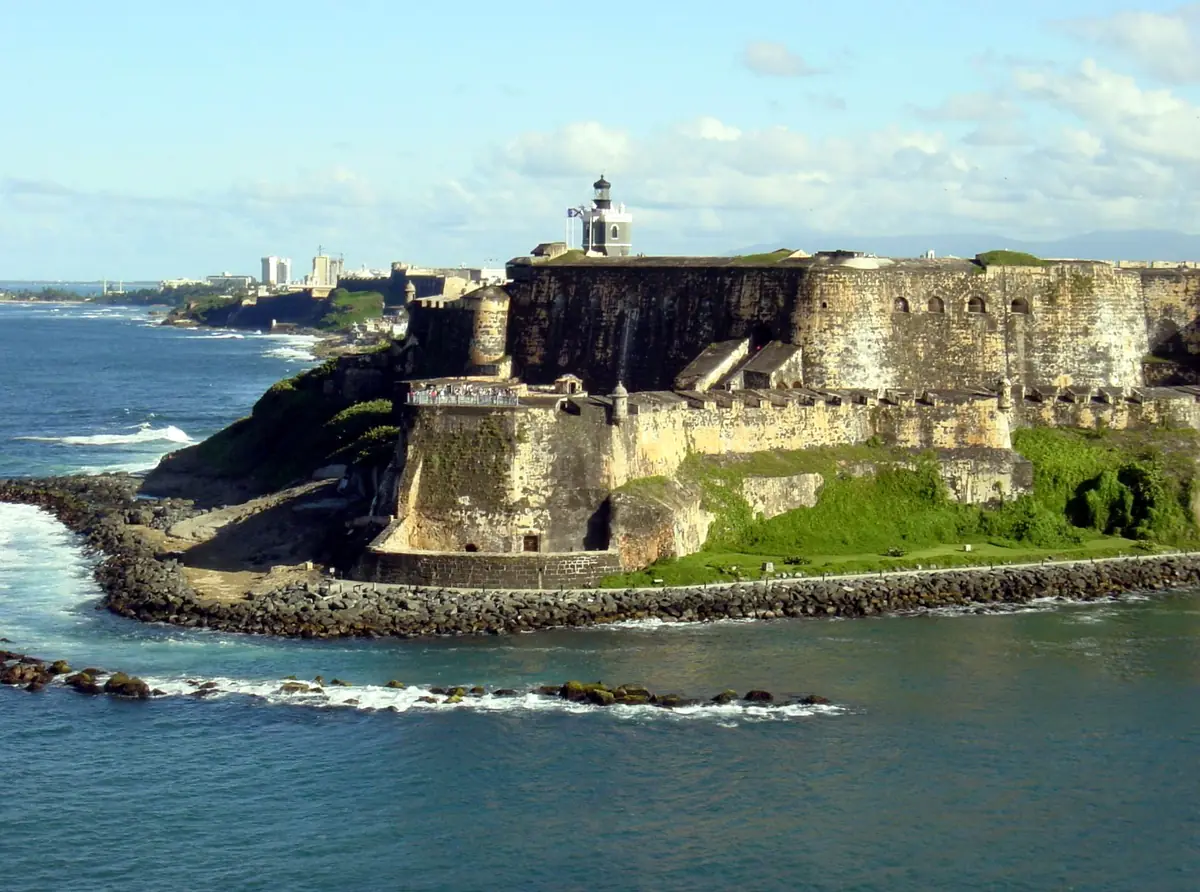
Castillo San Cristóbal rises over the eastern end of Old San Juan, its walls stepping down toward the Atlantic above the neighborhood of La Perla. Where El Morro guarded the harbor entrance from ships, San Cristóbal was built to stop an army coming overland from the east. The National Park Service calls it the largest fortress Spain built in the Americas. It sees fewer visitors than El Morro, which is a good reason to go: the tunnels, cisterns and dungeon here are some of the most atmospheric spaces in the old city, and the same ticket covers both forts.
Why it was built
Two attacks in quick succession exposed San Juan's weak side. In 1598 the Earl of Cumberland's English troops landed east of the city and took it from land, and in 1625 a Dutch force under Boudewijn Hendricksz besieged San Juan and burned much of the town before withdrawing. Spain responded by enclosing the city in stone walls and, from 1634, by fortifying the high ground at the northeast corner of those walls. One of the oldest surviving pieces of that early work is the Garita del Diablo, the "Devil's sentry box," perched on a lower outcrop facing the sea. Local legend says sentries posted there would vanish in the night.
The fortress you see today took more than 150 years to finish. Most of it dates from the late 18th century, when Spanish military engineers rebuilt San Juan's defenses using the Vauban style of angled bastions, a deep dry moat and outworks layered so that attackers would have to take one position after another while under fire. The park notes that the complex once covered about 27 acres.
The design worked. In 1797 a British force under Sir Ralph Abercromby landed east of San Juan and was turned back; the Park Service commemorates the "1797 Defense of San Juan" every year. On May 10, 1898, gunners at San Cristóbal fired on the U.S. auxiliary cruiser Yale, the first shots of the Spanish-American War in Puerto Rico. The U.S. Army later used the fort, and in World War II it added two coastal observation posts and a 1942 concrete bunker, which now serves as the visitor center.
What to see
San Cristóbal has three main levels connected by ramps, stairs and tunnels. Don't miss:
- The main plaza and casemates. Eleven vaulted, bombproof rooms with gun ports line the plaza; several now hold exhibits.
- The cisterns. Five cisterns under the plaza could store roughly 800,000 gallons of rainwater, letting the garrison hold out under siege.
- The dungeon, where drawings left on the wall by an unknown prisoner in the late 18th century survive.
- The tunnels and the moat. A network of passages let defenders move between positions unseen and reach the outworks.
- The upper gun decks, with views west to El Morro, down over La Perla and the Atlantic, and east toward the Capitol and Condado.
- The Garita del Diablo, visible from the walls on the ocean side.
Rangers give talks during the day, and a short film introduces the fortifications. Exhibits and films are in English and Spanish.
Fees and hours
San Cristóbal shares a ticket with El Morro: $10 per person 16 and older, valid at both forts for 24 hours, with children 15 and under free. National park passes are accepted. The park does not take cash, so bring a card or phone that pays contactless.
The forts open daily at 9 a.m. and close in the late afternoon (5 p.m. was the published closing time in early 2026), except Thanksgiving, Christmas and New Year's Day. Confirm current hours and any alerts on the San Juan National Historic Site website before you go.
Getting there
The fort's entrance is on Calle Norzagaray, a few minutes uphill from Plaza Colón at the eastern edge of the old city. That makes it the easiest of the two forts to reach on foot from the cruise piers or from a car parked in one of the public garages on the south side of Old San Juan (Covadonga and Doña Fela are the large ones). The Park Service estimates the drive from the airport at about 15 to 20 minutes in light traffic. Rideshare cars use a designated drop-off near Plaza Colón, a four- to five-minute walk from the entrance.
Public buses run by the Metropolitan Bus Authority (AMA) end at the Covadonga terminal near the port; routes and frequencies change, so check the AMA's current schedule. The Municipality of San Juan has run a free shuttle around the old city during some seasons, but it has not been a year-round service, so don't count on it.
Practical tips
- Allow 90 minutes to two hours. Add another two hours if you plan to walk to El Morro and see it on the same ticket.
- Start here, finish at El Morro. San Cristóbal is closer to the parking garages and piers; walking west along Norzagaray takes about 20 minutes and leaves you at El Morro's esplanade for late afternoon.
- Sun and heat: the upper decks are fully exposed. Bring water, a hat and sunscreen, and go early in the day if you can.
- Accessibility: an elevator reaches the main plaza, which has accessible restrooms and water fountains. The upper levels are reached by steep historic ramps, and the tunnel back to the main entrance is not wheelchair accessible. Call ahead to discuss accommodations.
- Footing: tunnels are dim and some stairs are uneven; wear closed shoes.
Nearby
Below the fort, Plaza Colón marks the site of the old Santiago Gate, the city's land entrance, and the Teatro Tapia stands on its south side. A short walk east along the coast brings you to the 18th-century Fortín de San Gerónimo, another link in the same defensive line, and to Escambrón Beach. The Capitol is about ten minutes on foot along Avenida Ponce de León. Heading west, Calle Fortaleza and Calle San Francisco lead into the heart of the old city.
Good to know
- Same $10 ticket as El Morro, valid 24 hours at both forts; no cash.
- The visitor center sits in a 1942 Army bunker.
- Ask a ranger to point out the prisoner's drawings in the dungeon; they are easy to miss.
- During the Fiestas de la Calle San Sebastián in January, the fort grounds and the walls between San Cristóbal and El Morro have been closed overnight.