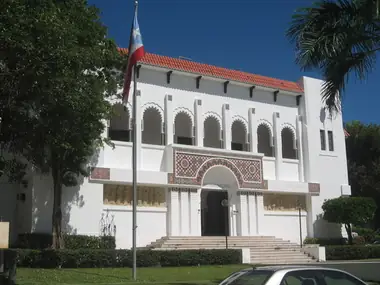
On Avenida Ponce de León in Puerta de Tierra, between the walls of Old San Juan and the white dome of the Capitol, stands a two-story building with Moorish-style arches and tilework. This is the Ateneo Puertorriqueño, the Puerto Rican Athenaeum, a cultural society founded in 1876 and often described as the island's oldest cultural institution. It is not a conventional museum with a ticket desk and audio guide. It is a members' institution that runs a theater, an art collection, literary and artistic prizes, lectures and festivals. For anyone interested in Puerto Rican literature, theater or painting, it is a worthwhile stop on a walk through Puerta de Tierra, and better still if you can catch an event there.
Why it matters
The Ateneo was born under Spanish rule, when opportunities for higher learning on the island were scarce. Its founders wanted to raise the educational and cultural level of the country and set out to promote science, literature and the fine arts. Some historians consider it the first institution of higher education in Puerto Rico, because it offered courses and an academy of painting where the painter Francisco Oller, some of whose works now hang in the Louvre, taught.
It was also the first Puerto Rican institution to give formal awards to writers and artists. Over the decades its honorees included José Gautier Benítez, Lola Rodríguez de Tió, Luis Lloréns Torres, José de Diego and Oller himself. The tradition continues: its Centennial Medal has more recently gone to El Gran Combo.
Strictly speaking, a couple of island organizations are older, including the Bar Association of Puerto Rico and the Casino de Mayagüez. But no other institution has been so closely tied to the island's literary and artistic life for so long.
A short history
The Ateneo was founded on April 30, 1876, at a meeting in San Juan's City Hall. Its founders included Manuel de Elzaburu y Vizcarrondo, usually credited as its main driving force, along with José Julián Acosta, the playwright Alejandro Tapia y Rivera and Francisco de Paula Acuña. Cayetano Coll y Toste was also important in its early administration.
In the 20th century the Ateneo became a center of debate about Puerto Rican identity. Its stated purpose today is to promote the affirmation and development of Puerto Rican nationality alongside its cultural and educational work. Nilita Vientós Gastón became its first woman president in 1946 and led it until 1961. The institution marked its centennial in 1976. Since 1937, its spaces have been reserved for activities it sponsors itself, rather than rented out.
The Ateneo has also served as a place of public mourning. Figures such as the actor Braulio Castillo, Walter Mercado and Rafael Cancel Miranda have lain in honor there.
The building
The current headquarters dates from the 1920s. Francisco Roldán Arce, an architect from Aguadilla, was asked to draw up plans in 1922, and the cornerstone was laid on May 27, 1923. The design is in the Spanish Morisco (Moorish revival) style, introduced to Puerto Rico by the architect Pedro de Castro, who also designed buildings nearby. In 2019 the building was designated a contributing property of the Puerta de Tierra Historic District.
It shares a monumental stretch of Ponce de León with several other public buildings: the Casa de España, the old Carnegie Library, the Capitol complex and the headquarters of the Puerto Rico Olympic Committee. Outside stands the Antorcha de la Descolonización (Torch of Decolonization), a sculpture by José Buscaglia Guillermety inaugurated in 2007. The words "Fin a la Colonia" (end to the colony) are inscribed on its cauldron, a clear statement of the institution's political outlook.
Theater at the Ateneo
The Ateneo's strongest legacy may be in theater. Tapia y Rivera, one of its founders, was a dramatist, and the Ateneo has held playwriting competitions since 1911. Writer Emilio S. Belaval founded the first professional theater groups there in 1938. Its Experimental Theater, founded in 1952, has staged more than 500 productions. In 1953 its small hall of about 200 seats hosted the premiere of René Marqués's La Carreta, now one of the best-known works of Puerto Rican drama. From 1973 to 2003 the Ateneo also ran a long series of theater festivals presenting new local and foreign work.
The art collection, music and film
The Ateneo holds several hundred artworks. The best known is Francisco Oller's La escuela del maestro Rafael Cordero, painted around 1890 in honor of the teacher Rafael Cordero. Other works in the collection, some viewable on the Ateneo's Google Arts & Culture pages, include portraits of Julia de Burgos, Eugenio María de Hostos and José Campeche, a painting of the Ponce Massacre, and a 19th-century view of San Juan from the city wall. Browsing the online collection before you go helps you know what to look for.
Music and film have their own programs. A string quartet performs under the Ateneo's Music Chair, and a Contemporary Puerto Rican Music Festival began in 2005. A cinema and video section, created in 1985 to support local film production, has produced two feature films.
Visiting
The best way to experience the Ateneo is to attend something: an exhibition, a play, a lecture or a book presentation. Programming varies through the year, and in 2026 the institution's website, ateneopr.org, was being redesigned and showed only a placeholder page. Before you go, check the Ateneo's current announcements through its official channels or call ahead to confirm what is open. Opening times and any admission charges were not published on an official page at the time of writing.
- Getting there: the Ateneo is on Avenida Ponce de León in Puerta de Tierra, a short walk east of Plaza Colón at the edge of Old San Juan. Walking is easy, though the avenue has little shade. Taxis and rideshare are simple.
- Parking: the building has only a small lot of about 14 spaces, one of them accessible. On weekdays it is often easier to park in an Old San Juan garage and walk.
- For events: arrive early. The experimental theater is small and popular shows fill up.
- Language: plays, lectures and most printed material are in Spanish.
Combine it with
The Ateneo sits on one of San Juan's most interesting walks. Continue east to El Capitolio, where the Constitution of Puerto Rico is on display, and then to El Escambrón beach for a swim. Heading west, Plaza Colón leads into Old San Juan, where the 19th-century Teatro Tapia continues the city's theater tradition and Castillo San Cristóbal overlooks the Atlantic.
Good to know
- Founded April 30, 1876; current building begun in 1923.
- Known for theater, literary and art prizes, and Oller's portrait of the teacher Rafael Cordero.
- Check current programming and opening times before visiting; the website was under redesign in 2026.
- Most activities are in Spanish.