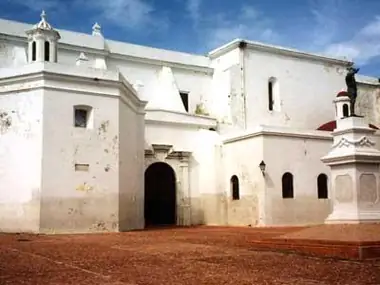
At the top of Old San Juan, where Calle del Cristo meets Calle San Sebastián, a church faces a small plaza with a statue of Juan Ponce de León. From the outside, the Iglesia de San José looks modest. Inside is one of the rarest buildings in the Western Hemisphere: a church begun in the 1520s, with Gothic vaults of a kind seldom seen outside Europe. After roughly two decades closed for restoration, it reopened in March 2021, and it is once again possible to step inside.
Five centuries of history
In 1522, Ponce de León, the island's first Spanish governor, gave this land at the northern edge of the young settlement to the Dominican friars. Construction began in 1528, and in 1532 the church was founded as the Church and Convent of Santo Tomás de Aquino. It is considered one of the earliest surviving examples of 16th-century Spanish Gothic architecture in the Americas, and it is often described as the second-oldest Spanish church still standing in the hemisphere, after the cathedral in Santo Domingo.
The building grew over time. It was remodeled in 1647, 1735 and 1772, the most recent barrel vault was completed in 1773, and the great doors of ausubo, a native hardwood, were installed in 1792. It came through the earthquake of 1787 largely undamaged, while the nearby cathedral suffered badly.
Ponce de León himself was buried in the church's crypt in 1559 and lay there until 1836, when his remains were moved to the Cathedral of San Juan Bautista. His grandson, Juan Ponce de León II, is still buried here, as is José Campeche, Puerto Rico's great 18th-century painter.
The Dominican convent was closed and secularized in 1836. In 1858 the Jesuits took over the church and renamed it for Saint Joseph, the name it carries today. Other orders ran the parish into the 20th century, and in 1969 management passed directly to the Archdiocese of San Juan. The convent buildings next door were acquired by the Puerto Rican government and in 1960 became the National Gallery of the Institute of Puerto Rican Culture.
Decline and a very long restoration
By 1950 the church was already in poor condition. To raise money for repairs, parishioners started a street festival that would grow into the Fiestas de la Calle San Sebastián, now the island's biggest party. Restoration under the historian Ricardo Alegría began in 1977, and the work turned up a mural of Saint Telmo from around 1540, Igneri artifacts dating to around 200 BCE and a 16th-century sword.
The church was closed again in the 1990s as the structure deteriorated: tree roots, termites and pigeon droppings had cracked the nave. A second major restoration began in the early 2000s. Volunteer-led and funded largely by private donations through the Patronato de Monumentos de San Juan, a nonprofit founded in 2009, it eventually cost around $11 million. Workers stripped modern cement from close to 17,000 square feet of walls so the old masonry could breathe, learned to make traditional lime and uncovered layers of murals, including a 19th-century painting of the Battle of Lepanto. Hurricane María in 2017 and the pandemic in 2020 slowed the final stages. The church was on the World Monuments Watch in 2004 and on the National Trust for Historic Preservation's list of America's 11 Most Endangered Historic Places in 2013.
It reopened with a rededication Mass in March 2021.
What to look for
- The Gothic vaulting of the nave and main chapel, the church's great treasure and an achievement rarely seen outside Europe.
- The rediscovered murals, including painted figures in the corners of one side chapel, such as mermaids in armor.
- A framed scar from a cannon shot that hit the church during the Spanish-American War in 1898; the restorers left it visible.
- A wooden 16th-century crucifix that Ponce de León is said to have donated.
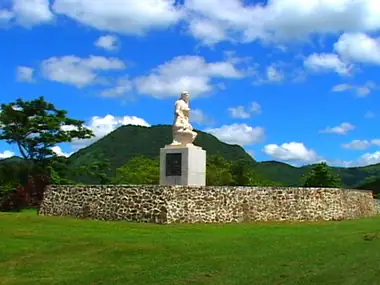
- Plaza San José outside, with the statue of Ponce de León that once stood in Plaza Colón.
Visiting
The church now functions as a chapel rather than a full parish. Opening hours are posted, but travel writers report that it is hit or miss whether the doors will be open when you arrive, so confirm before making a special trip and treat a visit inside as a bonus on a walk through the old city. Admission policies and Mass times can change; check with the Archdiocese of San Juan or ask locally.
If you do get in, remember that it is a consecrated church: dress modestly, keep your voice down, and don't use flash or walk around during services.
Getting there
San José stands on Calle San Sebastián at Plaza San José, in the upper part of Old San Juan, a few blocks from El Morro. From Plaza Colón or the cruise piers it is about a 15-minute uphill walk on cobbled streets. There is no parking at the church; use one of the public garages in Old San Juan and walk.
Practical tips
- How long: 20 to 30 minutes inside, longer if you linger over the murals.
- Footwear: the cobblestones are uneven and can be slippery after rain.
- Timing: mornings tend to be quieter in this part of the old city. Calle San Sebastián is lively at night and packed during the January festival.
- Tours: guided walks of Old San Juan, such as the Old San Juan Free Walking Tour, often pass through Plaza San José and can explain the area's history.
Combine it with
San José is the natural first stop on a walk down Calle del Cristo: past the cathedral to the little Capilla del Cristo on the city wall. In the other direction, the lawns of El Morro are a few minutes' walk away.
Good to know
- Founded in 1532 by the Dominicans; among the oldest churches in the Americas.
- Reopened in March 2021 after roughly 20 years of restoration costing about $11 million.
- José Campeche is buried here; Ponce de León was, until 1836.
- Opening hours are irregular; confirm before you go.