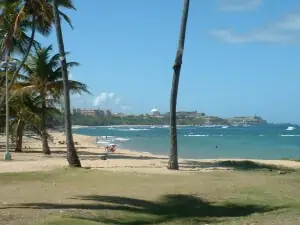
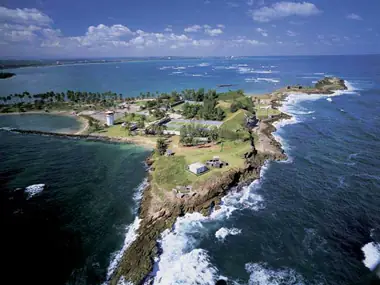
From the walls of El Morro, look west across the mouth of San Juan Bay and you will see a low, green spit of land with a small square fort at its tip. That is Isla de Cabras, Goat Island, in the Palo Seco area of Toa Baja. It is a quiet waterfront park where local families picnic, fish and swim in protected water, and it offers one of the best views of El Morro anywhere, from water level just across the channel. Add the little Spanish fort known as El Cañuelo and the ruins of a 19th-century leprosarium, and it makes an unusual half-day outing from San Juan, as long as you check that it is open before you go.
A guardian of the bay
Isla de Cabras and its neighboring rock sit at the western side of the entrance to San Juan Bay, surrounded by reefs and shoals. The Spanish saw the value of the spot early. Between 1608 and 1610 they built a small wooden fort on a key next to the island, across the channel from Castillo San Felipe del Morro. Its job was to catch enemy ships in a crossfire with El Morro, push them toward the shallows and guard the mouth of the Bayamón River, then an important route into the interior. According to tradition, a chain was once stretched across the channel between the two forts.
A Dutch attack in 1625 burned the wooden fort, and Spain later rebuilt it in masonry. This is Fortín San Juan de la Cruz, better known as El Cañuelo: a compact, square fort with a single sentry box. Posting there was so isolated, reachable only by boat, that it was probably used as a disciplinary assignment. By the early 1800s, El Morro's guns could reach past it, and it was no longer needed. In 1898, during the Spanish-American War, the U.S. Navy shelled it, and it survived.
In 1943 the U.S. Army Corps of Engineers dredged the bay entrance, and the dredged material joined El Cañuelo to Isla de Cabras, which in turn is linked to the main island by a road on landfill. During World War II, the U.S. Army also built a coastal battery here, Fort Amezquita, mounting heavy guns brought from the mainland.
The leprosarium
The island's other ruin has a sadder history. In the late 19th century Isla de Cabras became a leper colony. Governor Segundo de la Portilla laid the first stone of an official building to house patients on December 17, 1876, and it was completed in 1883. After 1898 the island government took over its management, and the 1910 census counted 35 residents. In 1926 the patients were moved to an asylum in Trujillo Alto. The walls of the old building still stand.
The park today
The land outside the military areas became the Isla de Cabras recreational park, which opened to the public in 1957. Its facilities were rebuilt between 1990 and 2004 and include gazebos, playgrounds, a boat ramp and a beach, and before the most recent changes it drew around 60,000 visitors a year.
The park has had a difficult few years. Hurricane Maria damaged it in 2017, and in 2022 FEMA approved more than $1.2 million for repairs to pavement, roofs, a wooden terrace, lighting and drainage. On September 1, 2022, management passed from the state to the Municipality of Toa Baja, which closed the park for improvements. In February 2023 the mayor reported it had reopened Wednesday to Sunday, 8 a.m. to 5 p.m., with free admission, restored restrooms and plans for paid parking, a restaurant run by a concessionaire and more gazebos. The fishing area on the rocks was still awaiting rehabilitation. No more recent official schedule was available at the time of writing, so contact the Municipality of Toa Baja before you go to confirm opening days, hours and any parking fee.
A Puerto Rico Police firing range has operated on part of the island since 1950. Don't be surprised to hear gunfire on training days, and stay out of fenced areas.
What to do
- Walk to El Cañuelo. The fort is part of the National Park Service's San Juan National Historic Site, which is a UNESCO World Heritage Site. Its interior is closed, but you can walk around the outside walls and look across the channel to El Morro.
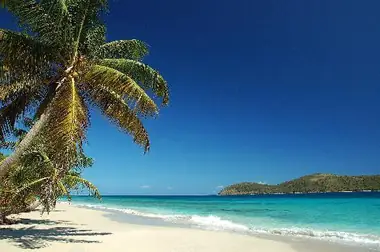
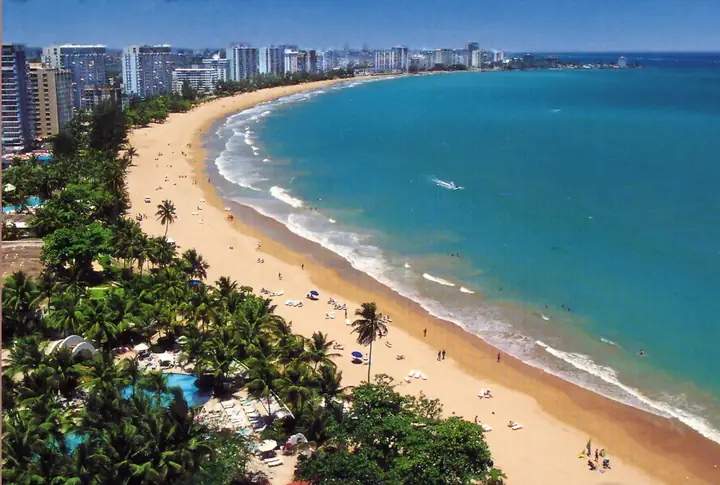
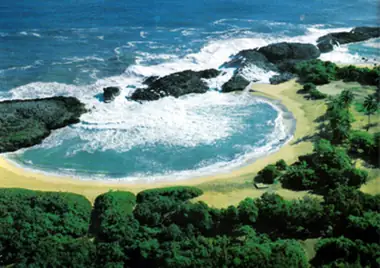
- Swim in the protected area. The park's beaches are sheltered by a stone wall and a natural cove, with a separate, buoyed zone for motorboats. Don't swim in the open channel: the bay entrance carries ship traffic and the water around the island is full of reefs and shoals.
- Fish. Recreational fishing is allowed in an area on the rocky shore, though its facilities have needed repairs. Bring your own gear.
- Picnic and watch the ships. Ships entering and leaving San Juan harbor pass through the channel in front of you.
Getting there
Isla de Cabras is in the Palo Seco barrio of Toa Baja, reached by road via PR-870, which crosses a causeway from the main island and passes El Cañuelo. Coming from San Juan, drive west through Cataño. A car is by far the easiest option. Without one, the San Juan–Cataño ferry crosses the bay from Old San Juan, but you would still need a taxi or rideshare from Cataño, and finding a ride back can take time.
Practical tips
- Check status first. Access has changed several times since 2017, and in the last reported schedule the park was closed on Mondays and Tuesdays.
- Bring supplies. Food service has been limited, so bring water, snacks and sun protection. Shade is limited outside the gazebos.
- Best light: afternoon, with the sun behind you, is best for photos of El Morro.
- Leave no trace. Pack out your trash.
Combine it with
Bacardí's distillery in Cataño lies just south of the island, so Casa Bacardí makes a natural pairing; tours are booked in advance through its official listing. Back in San Juan, visit El Morro itself and look back across the channel at El Cañuelo, the other half of the old crossfire.
Good to know
- Waterfront park in Palo Seco, Toa Baja, run by the municipality since 2022.
- El Cañuelo fort (National Park Service): exterior only.
- Last reported schedule (February 2023): Wednesday to Sunday, 8 a.m. to 5 p.m., free entry. Confirm before visiting.
- Swim only in the protected beach area.