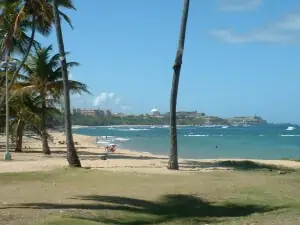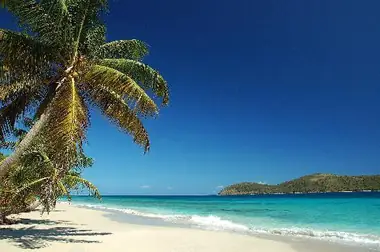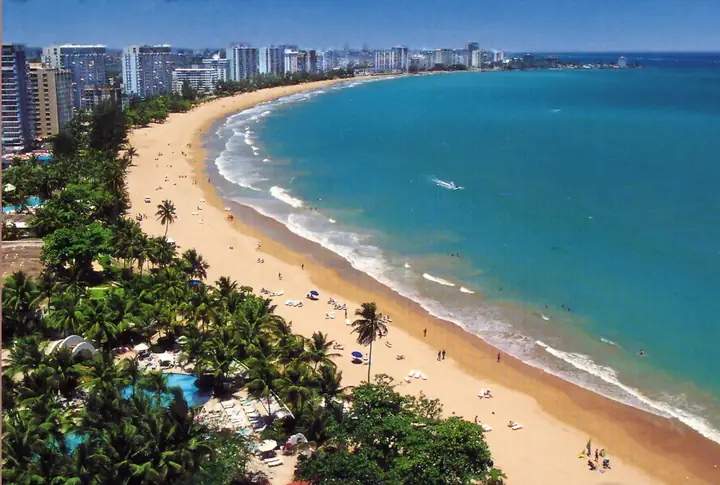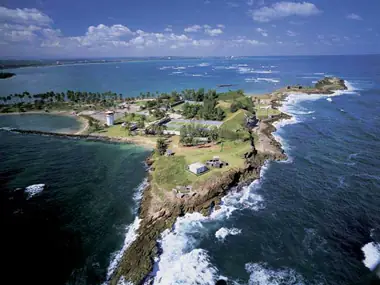
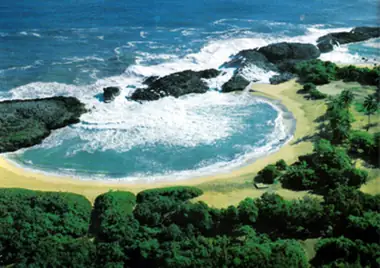
Mar Chiquita ("little sea") is a small oval cove on the north coast in Manatí, enclosed by walls of golden rock with a narrow gap where the Atlantic pours in. From the cliffs it looks like a private lagoon, and it is one of the most photographed beaches on the island. Manatí calls it the town's most popular beach. It is a good half-day trip from San Juan, provided you treat the water with care: the calm look of the cove is misleading.
How the cove was made
The rock walls are eolianite, sand dunes that hardened into stone over thousands of years. The beach itself is only partly natural. Local geologists describe it as "semi-natural": the rock and sand are original, but its shape was changed by people. Archaeologist Carlos Ayes Suárez has explained that in the 1950s a local merchant used dynamite to blast open the rock and enlarge the pool, which created the opening seen today.
Local storytellers prefer a legend. In it, a swimmer named Fini Ana fell into the deepest part of the pool and asked nature to save her. An earthquake split the rock, and a wave carried her safely to shore, leaving the cove in its present form. Either way, the result is unusual: a semicircle of sand almost closed off from the open sea.
The municipality maintains the area and has worked with researchers, including an archaeologist, a geologist and a biologist, on conservation education. In 2019 there was a proposal to declare Mar Chiquita an ecological reserve.
Swimming and safety
The rock wall works as a natural breakwater, so the waves inside are usually gentle. That gentleness is what makes Mar Chiquita risky. All the water that enters the cove has to leave through the same narrow channel, and when it flows out it can create a strong undertow that pulls swimmers toward the open ocean. There is no lifeguard.
- Stay away from the mouth of the cove and from the rocks, where currents are strongest.
- The bottom near shore is shallow and rocky, then drops off quickly. Wear water shoes and enter carefully.
- Stay out of the water when the surf is high. In winter, waves can break right over the rock walls.
- Do not walk on the rocks in flip-flops. The limestone is sharp, and wet patches are slippery.
Summer usually brings the calmest conditions. On still days at low tide, snorkelers look for fish near the rocks on the east side of the cove, and some visitors have reported seeing manatees, which is fitting for a town named Manatí. Do not count on it, and never approach or touch a manatee if you see one.
What else to see
- The rock walk. Walk the shoreline rocks (carefully) for views back over the cove and out to sea. Beachcombers find sea glass along the shore.
- The grotto. In the southwest part of the parking area is a small shrine to the Virgen del Carmen set in a cave with stalactites and stalagmites.
- A second cove. East of the main beach, past an old concrete wall, is a second, partly sheltered cove that is usually quieter.
Getting there
Mar Chiquita is about 45 minutes' drive west of the San Juan area. Take PR-22 west to exit 46, then go north on PR-686, west on PR-685 and north on PR-648, following that road to its end at the beach. There is no practical public transport. Parking is on a free, packed-sand lot. Car break-ins have happened here, so leave nothing visible in the car and park near other people or the food stands.
Facilities
Entry is free. Facilities are basic and vary. Food kiosks open mainly on weekends and may be closed midweek. Portable toilets have been placed in the parking area at times, especially in summer, but there are no permanent restrooms or showers, so do not count on them. The municipality has provided trash bins and areas for beach volleyball. Bring water, snacks if it is a weekday, a towel and a bag for your trash.
When to go
- Weekdays are much quieter. Weekends, holidays and summer are busy, and the kiosks are open.
- Summer generally brings calmer seas. Check the surf and the rip current forecast before you drive out; if the sea is rough, enjoy the view from the rocks instead.
- The town holds a beach festival at Mar Chiquita in June; expect crowds that weekend.
Nearby on the north coast
Manatí, known as the "Athens of Puerto Rico," has other beaches along this coast, including Los Tubos, which has its own summer festival, and La Poza de las Mujeres, a rock pool that is considered dangerous for swimming. The Cueva de las Golondrinas is also close by. Just east is Laguna Tortuguero, a large lagoon between Vega Baja and Manatí. Driving west along the coast, you reach Arecibo and the Cueva del Indio, a sea cave with Taíno petroglyphs. For restaurants and places to stay in town, see the Manatí directory.
Good to know
- Where: end of PR-648, Manatí, north coast; about 45 minutes from San Juan.
- Free entry and free parking on a sand lot.
- No lifeguard. Strong undertow near the cove's mouth; avoid the rocks and rough days.
- Water shoes recommended; the bottom is rocky and drops off quickly.
- Kiosks mostly open on weekends; facilities are basic.