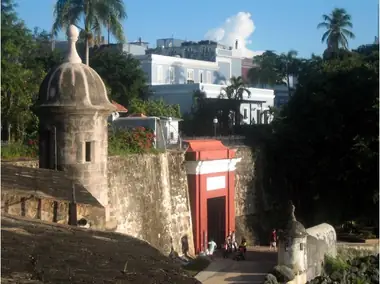
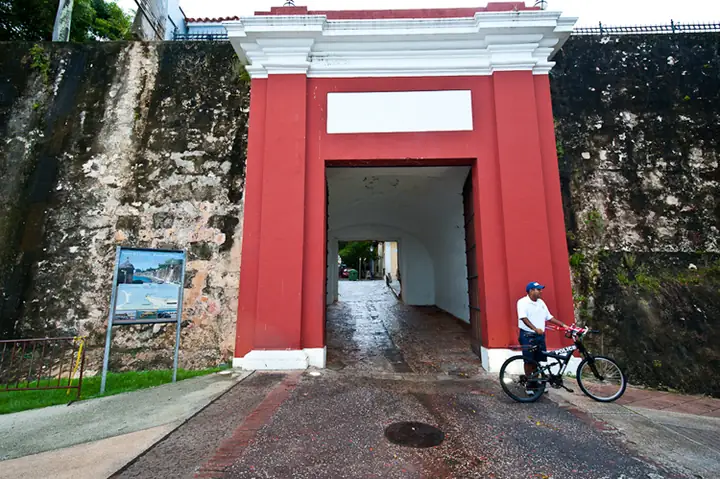
The Puerta de San Juan, or San Juan Gate, is a red-painted stone archway set into the massive city wall on the western edge of Old San Juan, just below the governor's mansion. For centuries, anyone of importance arriving by sea stepped ashore nearby and walked through this opening into the city. It is the only one of the old city gates still standing, and it is part of San Juan National Historic Site, managed by the National Park Service. It takes a minute to walk through, but it is one of the most rewarding minutes in the old city.
Why the gate matters
After the English captured San Juan in 1598 and the Dutch burned it in 1625, Spain set out to enclose the whole city in stone. Work on the walls began in 1634, and over the next century and a half they grew until, by the 1780s, they encircled the city entirely. The San Juan Gate dates from that first phase of construction in the 1630s.
The walls had a handful of gates, each closed at night to seal the city. On the land side, the Puerta de Santiago, also called the Puerta de Tierra, opened toward the rest of the island near where Plaza Colón is today. The San Juan Gate was the water gate. Ships anchored in the sheltered bay below, and new governors and bishops came ashore at the cove known as La Caleta and passed through this gate in formal procession, and, by tradition, continued uphill to the cathedral to give thanks for a safe crossing.
By the late 19th century the city was outgrowing its walls. The southeastern stretch, including the land gate, was demolished as San Juan expanded east. About three-quarters of the original wall system survives, and the San Juan Gate is the one entrance that remains and still works as one.
What to look for
- The inscription. Above the arch on the outer side is a Latin phrase from the liturgy, "Benedictus qui venit in nomine Domini," "Blessed is he who comes in the name of the Lord," a welcome to those arriving by sea.
- The thickness of the wall. Walking through the passage gives you a real sense of how massive the defenses were.
- The view back out. From inside, the gate frames San Juan Bay. From outside, look up to see La Fortaleza sitting on the wall directly above you.
- La Caleta de San Juan, the short, steep street running uphill from the gate toward the cathedral, lined with colonial houses. It was the first stretch of the governors' processional route.
How to get there
The easiest approach is along the waterfront. From the cruise piers or the parking garages on the south side of the old city, walk west along the Paseo de la Princesa: past the old La Princesa prison and the Raíces Fountain, then along the foot of the walls. The Paseo ends at the gate. The walk is flat, paved and shaded in part, about 15 to 20 minutes at an easy pace.
From inside the old city, head to the bottom of Calle del Cristo or the cathedral and follow La Caleta de San Juan downhill. The street is steep and cobbled.
There is no parking at the gate. Drivers should use the public garages on the southern edge of Old San Juan (Covadonga and Doña Fela are the largest) or the La Puntilla lot near the start of the Paseo, keeping in mind that La Puntilla has been reserved for residents during large festivals.
Practical tips
- When: any time; the gate is outdoors and free. Late afternoon is best for light and for the sunset over the bay. Early morning is the time for photos without people in them.
- How long: five to ten minutes at the gate itself. Build it into a one- to two-hour loop of the old city.
- Accessibility: the approach along the Paseo de la Princesa is level and wheelchair friendly. Going through the gate and uphill along La Caleta is steep; if that is a problem, see the gate from the Paseo side and return the way you came.
- After dark: the area is lit and usually has people around in the evening; as anywhere, stay alert late at night.
The Paseo del Morro beyond the gate
Outside the gate, the waterfront path continues north along the base of the walls as the Paseo del Morro, a National Recreation Trail heading toward El Morro. The Park Service closed it in 2023 because of a water leak through the historic wall, and in 2026 part of the trail closed again for a wall restoration project by the U.S. Army Corps of Engineers, expected to last more than a year. Before you plan to walk it, check current conditions on the San Juan National Historic Site website.
A good walking loop
- Start on the Paseo de la Princesa near the piers and walk west to the gate.
- Pass through and climb La Caleta to the Cathedral of San Juan Bautista.
- Walk down Calle del Cristo to the Capilla del Cristo and Parque de las Palomas, which looks out over the same walls you just walked beneath.
- Continue to La Fortaleza, then wander east along Calle Fortaleza for lunch.
- With more time, head uphill to El Morro for the afternoon.
Good to know
- Free and open at all hours; it is an outdoor monument.
- It is the only surviving gate of the old city walls.
- The Paseo de la Princesa approach is the flattest route.
- Check the Paseo del Morro's status with the Park Service before walking north from the gate.