
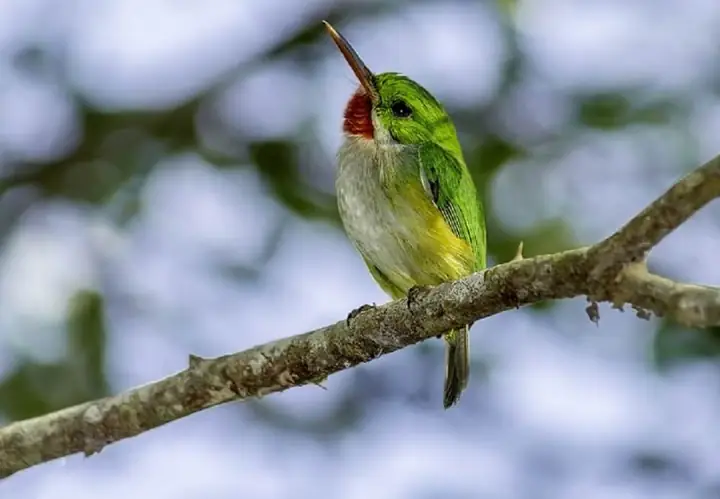
Puerto Rico is a small island with an outsized bird list. About 385 species have been recorded here, though more than half of those are rare strays. What draws birders is the core of resident species found nowhere else on Earth: around 16 living endemics, depending on the taxonomy you follow, from the tiny, jewel-green Puerto Rican tody to one of the rarest parrots in the world. Because the island is compact, rainforest, dry forest, mountains and salt flats are all within a few hours' drive of each other, so a single trip can cover very different habitats.
The endemics
These are the birds most visiting birders come for:
- Puerto Rican tody (San Pedrito): a tiny, bright green bird with a red throat, and a favorite of local birders.
- Puerto Rican woodpecker, Puerto Rican flycatcher, Puerto Rican vireo and Puerto Rican lizard-cuckoo.
- Two hummingbirds, the Puerto Rican emerald and the green mango.
- Puerto Rican tanager and Puerto Rican spindalis, each now placed in its own bird family.
- Puerto Rican oriole and Puerto Rican bullfinch.
- Adelaide's warbler and the much more localized elfin-woods warbler, which was only described by scientists in 1972.
- Puerto Rican nightjar, a ground-nesting bird of the southwestern dry forests.
- Yellow-shouldered blackbird, an endangered species of the southwest coast and Mona Island.
- Puerto Rican parrot (Amazona vittata), the island's most famous bird.
Several other endemic birds, including a parakeet and a barn owl, are already extinct, which is a reminder of how fragile island species are.
The Puerto Rican parrot's comeback
The Puerto Rican parrot is the only native parrot in the United States and has been protected as endangered since 1967. It is mostly green, with a red forehead, white eye-rings and brilliant blue flight feathers that flash when it flies. The U.S. Fish and Wildlife Service, the U.S. Forest Service and Puerto Rico's Department of Natural and Environmental Resources (DRNA) run a joint recovery program with two breeding aviaries: Iguaca in El Yunque National Forest and the José Vivaldi aviary in Río Abajo State Forest.
Hurricane María in 2017 was a disaster for the species. The entire wild flock in El Yunque was lost, and Río Abajo lost about 40 percent of its birds. Releases of captive-bred parrots resumed in 2020 in El Yunque and Río Abajo, and in 2022 in Maricao, where a third wild population is being established. The program's February 2026 update estimates 320 to 340 wild parrots at Río Abajo, 100 to 105 in El Yunque and 100 to 105 in Maricao, with more than 900 birds in total counting those in captivity. Some released pairs now nest in natural tree cavities, an important sign of recovery.
Seeing a wild parrot still takes luck and patience. The surest way to see one is at El Portal Rainforest Center in El Yunque, which has had a permanent live display of Puerto Rican parrots since it reopened in 2022.
Where to go
El Yunque National Forest (northeast)
The island's rainforest, in the mountains east of San Juan, is the easiest place to start. It is where the elfin-woods warbler was first found, in 1971, and where parrot releases resumed in 2020 after María. Start at El Portal. See our El Yunque guide for access rules and hours.
Río Abajo State Forest (karst country, Arecibo and Utuado)
This limestone forest now holds the largest wild parrot population, first established in 2006, and the DRNA's José Vivaldi aviary. Breeding pairs here have been found using natural tree cavities. With the most wild birds, it offers the best odds of a sighting.
Maricao State Forest (western mountains)
Maricao has the largest known population of the elfin-woods warbler, which reaches its highest densities in the forest's podocarpus stands, and it is the site of the newest wild parrot population. See our Maricao directory for places to stay and eat nearby.
Guánica State Forest (southwest)
This dry forest, a UNESCO biosphere reserve since 1981, covers almost 10,000 acres. About half of Puerto Rico's bird species and nine of its endemics occur here, and it is a stronghold of the Puerto Rican nightjar, which also lives in the Susúa State Forest and the hills around Guayanilla. Adelaide's warbler and the Puerto Rican vireo are typical dry-forest birds. The forest has 12 trails. Go at first light, because it gets hot quickly. The nightjar nests on the ground, with nesting peaking from April to June, so stay on the trails.
Cabo Rojo salt flats (southwest)
The Cabo Rojo National Wildlife Refuge protects mangroves, dry forest and the pink hypersaline lagoons of the Cabo Rojo salt flats, one of the island's most important sites for shorebirds. It is critical habitat for the yellow-shouldered blackbird, and it is the only place in Puerto Rico where Snowy Plover nests have been recorded; Least Terns and Wilson's Plovers also nest here. The Salt Flats Unit has an observation tower, an interpretive center and three trails. As of 2026, the tower is open Monday to Saturday and the interpretive center Wednesday to Saturday, both 8:00 a.m. to 3:30 p.m.; the main road to refuge headquarters is temporarily closed while a new visitor center is built. Combine it with the Cabo Rojo lighthouse at the tip of the peninsula.
Culebra and Mona (offshore)
The Flamenco Peninsula on Culebra is a major nesting site for the Sooty Tern, with more than 30,000 pairs, inside the Culebra National Wildlife Refuge (see our Culebra guide). Mona Island, far off the west coast, has its own subspecies of the yellow-shouldered blackbird; a trip there takes serious planning.
When to go
- Year-round: all the endemics are resident, so any month works for them.
- Cooler months (roughly late fall to early spring): migratory birds from the north use the island's forests and wetlands, adding variety to the list, especially at coastal sites such as the Cabo Rojo salt flats.
- Spring and early summer: breeding season for many residents. Nightjar nesting peaks April to June, and terns and plovers nest on beaches and salt flats.
- Hurricane season runs from June through November. Storms can close forests and trails for long periods, so check conditions before you travel.
Tips for birding in Puerto Rico
- Start at dawn. Activity drops sharply by late morning in the heat, especially in the dry forests.
- Hire a local guide for a day or two if you want the hard species, such as the elfin-woods warbler, nightjar or wild parrots. Local guides know current sites and calls.
- Use a car. The best sites are spread across the island, and public transport does not reach them.
- Respect endangered birds. Keep your distance from nests, stay on trails and avoid using recorded calls to lure rare species.
- Check closures. Hurricanes, earthquakes and repairs have closed forests and roads in recent years. Check the DRNA, the Forest Service or the refuge's page before each visit.
- Bring binoculars, insect repellent, rain gear for the mountains, sun protection for the coast and plenty of water.