The Bosque Estatal de Maricao, known to almost everyone in Puerto Rico as Monte del Estado, covers the high ridges of the western Cordillera Central above the town of Maricao. At about 10,800 acres it is the largest unit in the island's state forest system, and it is one of the best places in Puerto Rico to see endemic birds. It is also simply a cool place to escape the coast: the air up here is noticeably fresher, and winter nights can be cold by Caribbean standards. Visitors come for birding, short forest walks, the view from a stone lookout tower and a night or two in a mountain cabin or campsite.
What makes this forest different
The forest was established by proclamation in December 1919 and is managed by the Department of Natural and Environmental Resources (DRNA). It spreads across parts of Maricao, Sabana Grande and San Germán. What sets it apart is the ground under it. Almost all its soils come from serpentinite, a rock that weathers into a red, shallow, acidic clay rich in iron. The forest holds more than 1,100 plant species, including 23 of the plants found only in Puerto Rico. There are also plantations of mahogany, eucalyptus and Honduran pine from past forestry work.
The climate is wet. A weather station near Maricao averages about 93 inches of rain a year. Summer brings warm, humid days with frequent afternoon thunderstorms, while winter is drier, with mild days and cold nights that occasionally drop toward 40°F.
Birding
About 136 bird species have been recorded in the forest, 23 of them endemic to Puerto Rico. The star for most birders is the elfin-woods warbler, a small endemic warbler that is relatively common in the high-elevation forest around Maricao. Most of the island's other endemics occur too, including the Puerto Rican tanager, tody, emerald, lizard-cuckoo, vireo, spindalis, oriole, woodpecker and bullfinch, and the Puerto Rican screech-owl calls from dusk to dawn. In winter, migrant warblers from North America join them.
The forest is also a refuge for the Puerto Rican subspecies of the sharp-shinned hawk, which is critically endangered. Its population fell sharply after Hurricane María in 2017 and has been recovering. In late winter and early spring, males sometimes perform display flights near the stone tower shortly after sunrise.
Birders usually focus on three spots along PR-120:
- The trailhead at km 16.8, where an unpaved path descends about 1 km through intact upper-elevation forest. It is the most reliable spot for the elfin-woods warbler. The path is in good shape at the top but becomes overgrown farther down. Parking is a tiny pull-off on a curve where cars travel fast, so take care.
- The park complex, roughly 700 meters east, with gentler, better-kept trails through lower forest.
- Torre de Piedra, the stone tower, a kilometer or two farther east.
For more birding sites around the island, see the site's bird-watching guide.
The stone tower and other landmarks
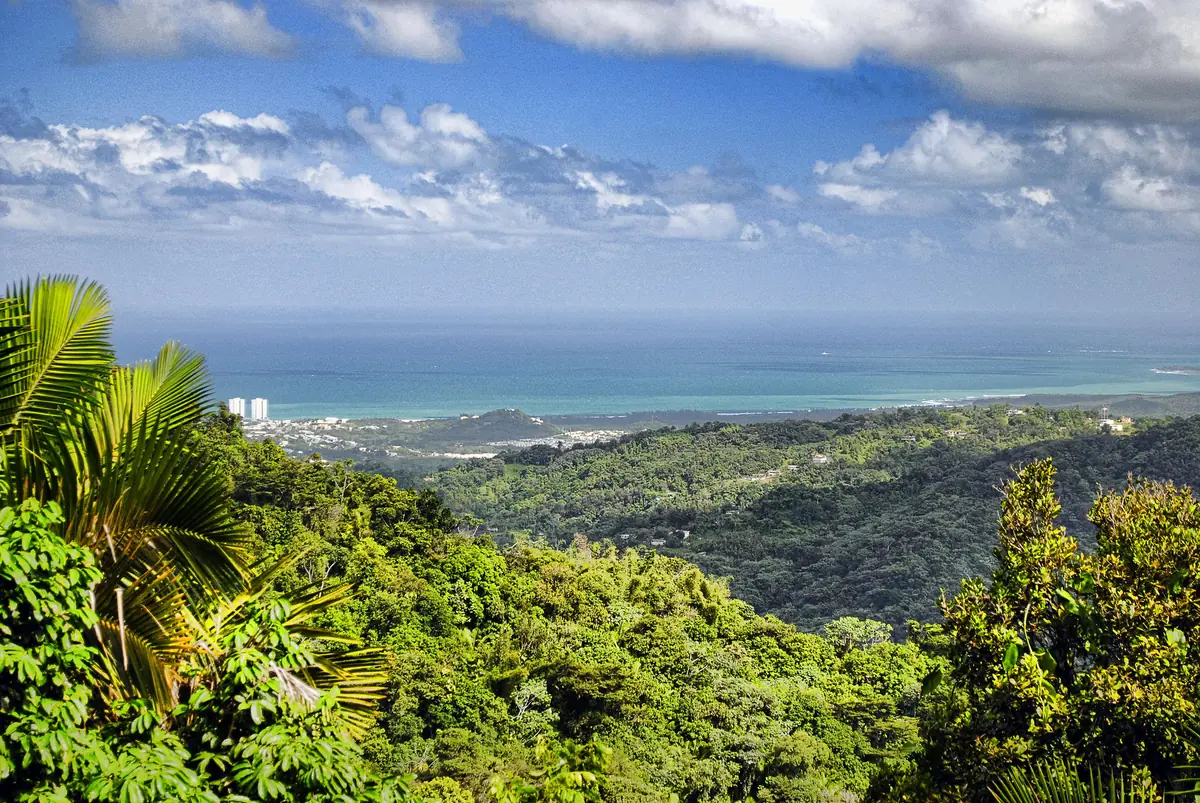
The Santa Ana observation tower, better known as the Torre de Piedra, is a stone lookout on a high point of the forest with a small parking area and a short climb to the top. On a clear day the view reaches Mayagüez and the coast, and even Mona Island far out to sea. For many visitors driving the mountain road it is the main stop.
The forest also preserves traces of the 1930s, when the Civilian Conservation Corps worked in Puerto Rico's forest reserves. The ruins of the Casa de Piedra (Stone House) date from that era, and the Maricao Fish Hatchery, built in 1937 for research, is listed on the National Register of Historic Places among the New Deal buildings of the island's forests. Check with the DRNA whether the hatchery is open to visitors before you go.
Several waterfalls and swimming holes lie within the forest, including Salto Curet on the Río Lajas and Charco El Pilón. El Pilón is reached from Route 362 by a rocky trail of about 45 minutes to an hour. Expect overgrowth on the trail, and skip it if the weather turns bad.
Cabins and camping
The Centro Vacacional Monte del Estado, on PR-120, has 24 two-bedroom cabins that each sleep up to six, with a kitchen, bathroom and a fireplace for the cool nights, plus a pool and recreation areas. The center reopened after Hurricane María in 2018, and later reports indicate the cabins are renting again. Guests have typically needed to bring their own sheets, pillows and kitchen utensils.
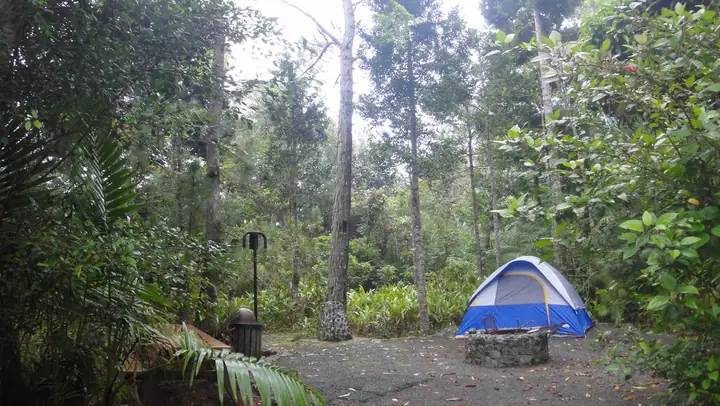
A short way down the road is a small campground with gravel tent sites, picnic tables, grills and bathrooms with showers. Camping requires a permit from the DRNA, usually requested in advance by phone or online, and the gate is locked at night. Contact the DRNA (main line 787-999-2200) for current rates, availability and permit forms before planning a stay.
Getting there
The forest lies along the Ruta Panorámica, the scenic route that runs along the island's mountain spine, and its trails and facilities are reached from PR-120. You need a car: there is no public transport, and walking along the narrow, winding PR-120 is dangerous. Allow extra time for the drive, since mountain roads in the west are slow and twisting.
Practical tips
- Bring layers and a rain jacket. It is cooler and wetter than the coast.
- Wear shoes with grip. Trails are often wet and slippery.
- Go early. Birds are most active in the first hours after sunrise, and afternoon storms are common in summer.
- Stock up first. Bring food and water rather than counting on buying supplies in the forest.
- Drive carefully and pull fully off the road when stopping to look at birds.
Combine it with
Drop down the mountain to the historic town of San Germán and its 17th-century church museum, Porta Coeli, or continue to the coast at Boquerón. For a small private cabin elsewhere in Maricao, see Hacienda Silvana and other listings in the Maricao directory.