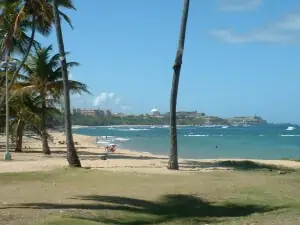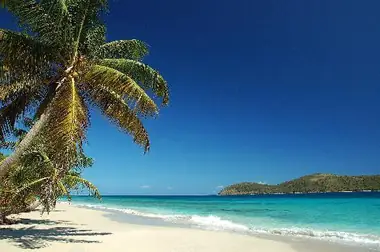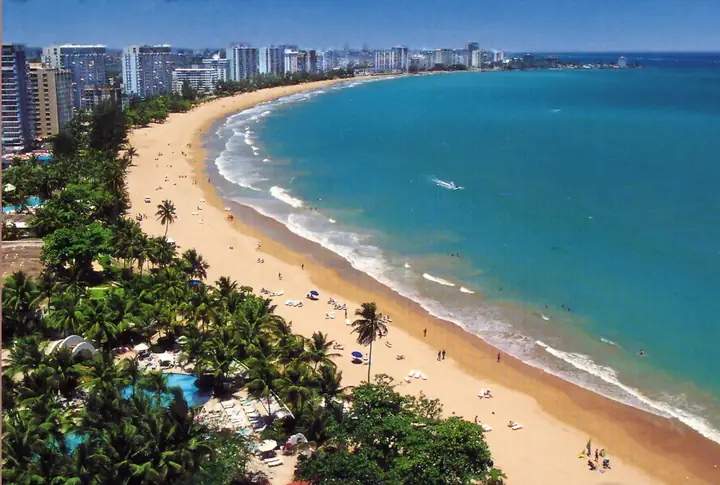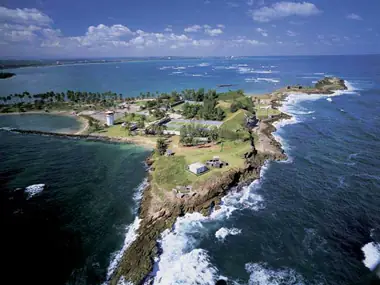
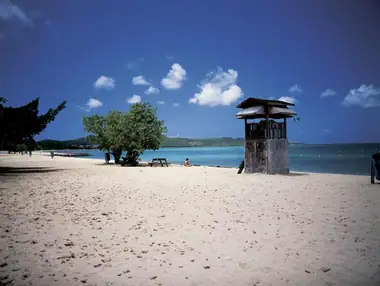
Boquerón is a seaside barrio of Cabo Rojo, on a wide, sheltered bay in the far southwest of Puerto Rico. It has two personalities. By day it is a family beach town built around one of the island's best-known public beaches, with shallow, calm water and shade trees. On weekend nights the small village center, known as El Poblado, closes its waterfront street to cars and fills with people eating seafood, drinking and singing karaoke outdoors. It is also a convenient base for the rest of Cabo Rojo: the salt flats, the lighthouse cliffs and several quieter beaches are all a short drive south.
The public beach (Balneario de Boquerón)
The Balneario de Boquerón is a government-run public beach and vacation center on the bay, with a long curve of sand, palms and a large parking area. It has repeatedly been rated among the best beaches in Puerto Rico and has held Blue Flag status, the international award for water quality, safety and environmental management. The bay faces west and south and is protected from the open ocean, so on most days the water near shore is shallow, clear and gentle, which makes it a favorite with families with small children. Mornings are usually the calmest and clearest time to swim.
Who runs it now. For years the balneario was managed by the National Parks Company and then by the Department of Natural and Environmental Resources (DRNA). The DRNA has since leased the beach's facilities and common areas to the Municipality of Cabo Rojo, which created a municipal program under its tourism development office to operate them. A municipal ordinance approved in September 2025 sets fees for vehicle entry, overnight motorhome and van parking, tent areas and vendor spaces. Because fees and opening days have changed with the handover, check with the Municipality of Cabo Rojo before you go.
Cabins and villas. The vacation center's cabins and villas were badly damaged by Hurricane María in 2017 and have reopened only gradually and partially since then. Do not count on renting one without confirming availability directly.
Water quality after rain. Water at the beach is tested regularly, but samples sometimes fail after heavy summer rain, when runoff from the Caño Boquerón drains into the bay. The southern end, near the channel, is the area to avoid after storms. Lifeguard coverage has not been consistent in recent years, so supervise children closely.
El Poblado: food and nightlife
El Poblado, the village center a short walk north of the balneario, is known around the island for food and nightlife. Small kiosks and street stands sell seafood snacks such as clams, shrimp, pinchos (skewers) and empanadillas, including ones filled with chapín (trunkfish). Restaurants along the waterfront serve local, international and fusion menus built around the fish and shellfish Cabo Rojo is known for. Bars range from pool halls to tiny open-front spots, many pouring flavored mojitos.
On weekends the one-way coastal street is closed to traffic, and the whole strip becomes a pedestrian zone with music, crafts and outdoor karaoke spilling into the street. It is lively and loud, and mostly a local crowd. El Poblado is also known as one of the most LGBT-friendly places on the island and hosts a Pride parade every June. If you want a quiet evening, come on a weekday.
Nature around Boquerón
- Cabo Rojo National Wildlife Refuge. Two national wildlife refuges lie within Boquerón. The Cabo Rojo refuge's Salt Flats unit, toward the southern end of PR-301, has an interpretive center, an observation tower over the salt ponds and three short trails through mangroves and dry forest. As of 2026 the U.S. Fish and Wildlife Service lists the interpretive center as open Wednesday to Saturday, 8:00 a.m. to 3:30 p.m. The refuge protects habitat for native birds, including the endangered yellow-shouldered blackbird. See the site's bird-watching guide for more.
- Boquerón State Forest. One of the DRNA's state forests, it is made up of coastal parcels including mangroves, the Joyuda lagoon area and Isla de Ratones off Joyuda.
- Laguna Rincón. A lagoon within the barrio, worth a stop if you are birding.
Local folklore also places a pirate's hoard nearby: the story goes that the pirate Roberto Cofresí hid treasure in a cave in Barrio Pedernales, just north of the bay. Nobody has found it.
Getting there and parking
Boquerón is in the southwest corner of the island. From the San Juan area, plan on roughly two and a half to three hours by car, much of it on PR-2. From Mayagüez it is about 30 to 40 minutes. A rental car is close to essential, since public transport in the southwest is limited.
The balneario's own lot has direct access to the beach. When it fills, there is overflow space behind the villas, and drivers also park on village streets such as Road 307 and Calle Luis Muñoz Rivera and walk in. On holiday weekends and summer Sundays, arrive early.
Practical tips
- Best time. Weekday mornings for a quiet swim. Friday and Saturday nights for the Poblado scene.
- After heavy rain, skip swimming near the channel at the south end of the beach for a day or two.
- Bring sunscreen, water, a hat and cash for kiosks and parking.
- Car safety. Leave nothing visible in your car, especially when parking on the street at night.
- Events. Big festivals and fairs are sometimes held at the balneario, such as the island tourism company's internal tourism fair in July 2026. They bring heavy traffic, so check the calendar before planning a quiet beach day.
Combine it with
Drive south on PR-301 to the salt flats, then continue to the Cabo Rojo Lighthouse and the cove of Playa Sucia below it. For a beach with a younger crowd and big sunsets, try El Combate, reached by its own short road off PR-301. To the east, La Parguera in Lajas offers boat trips to the mangrove cays. Inland, the hilltop chapel of Porta Coeli in San Germán makes a good rainy-day alternative. For places to eat and stay, browse the Cabo Rojo directory.
Good to know
- Where: Boquerón, Cabo Rojo, on Boquerón Bay in southwestern Puerto Rico.
- The public beach is now operated by the Municipality of Cabo Rojo under a lease from the DRNA. Confirm fees and days before you go.
- The water is usually calm and shallow, but avoid the south end after heavy rain.
- Weekends in El Poblado mean a car-free street, crowds and music.