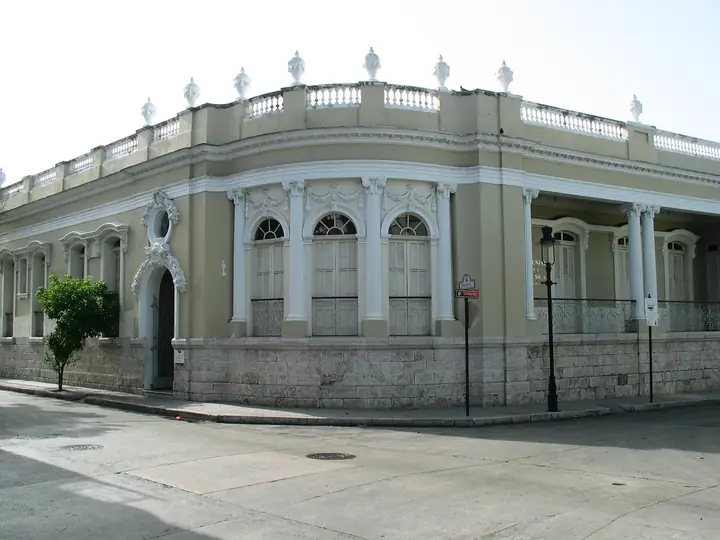
Ponce has deep musical roots. The danza, the elegant ballroom music of the 19th century, took shape here, and the plena, the island's drum-driven "sung newspaper," was born in one of the city's neighborhoods around 1900. So it makes sense that the island's museum of Puerto Rican music is in downtown Ponce. The Museo de la Música Puertorriqueña, run by the Instituto de Cultura Puertorriqueña (ICP), fills a family mansion a short walk from Plaza Las Delicias with instruments, scores, posters and memorabilia that tell the story of the island's music from Taíno times to popular music. It is small, inexpensive and a good hour's stop on a day in the historic center.
The house
The museum occupies the Casa Serrallés, at the corner of Calle Isabel and Calle Salud. It was built as the downtown home of Félix Juan Serrallés and his wife, Francisca Nevárez. He was a grandson of Juan Serrallés, founder of the distillery that makes Don Q rum. This was the family's everyday residence in town, separate from the much grander Castillo Serrallés they later built on the hill above the city. Look in the back patio for an open-air bar that still carries the logos of the Serrallés distillery and Don Q.
The museum itself has moved around. Its first home, opened in 1991, was a villa on Calle Cristina that now houses the Centro Cultural de Ponce. The ICP moved the collection to the Serrallés house in 1996. Since 2004, the ICP has owned the museum while the Municipality of Ponce has been responsible for the building's security and upkeep.
What you will see
The exhibits follow Puerto Rican music through its three main roots: Taíno, Spanish and African. Displays are in Spanish and English, and screens help show how each style developed. According to the ICP, the collection includes instruments that belonged to some of the island's great musicians, along with sheet music, posters and works by classical, contemporary and popular composers.
Indigenous roots
The exhibits start with the instruments of the island's indigenous Taíno people. Among the percussion on display is the güiro, also called güicharo, a hollowed gourd scraped to keep the rhythm. It is still heard today in plena.
Spanish strings
Spanish settlers brought the guitar, and on the island it evolved into a family of local string instruments. The museum displays local variants of the six-string guitar such as the requinto and the bordonúa.
The danza
The danza was the favorite music of 19th-century Puerto Rican high society, a ballroom genre that emerged around the 1840s in reaction to the stiffer contradanza, with influence from Cuban music. Manuel Gregorio Tavárez is considered its father, and his student Juan Morel Campos brought it to its peak, writing more than 300 danzas. A typical romantic danza gives a solo to the euphonium, known locally as the bombardino. Even Puerto Rico's anthem, La Borinqueña, began life as a danza.
Bomba and plena
Bomba and plena carry the island's African heritage. Plena began around 1900 in Barrio San Antón, in Ponce, played on hand drums called panderos or panderetas, with the güiro. Its songs passed along the news of the day, from crimes and hurricanes to politics and love affairs, often with a satirical edge. Ponce's upper class was not amused at first: in 1917 the city banned plena dances within city limits. Its best-known performers include Manuel "El Canario" Jiménez, Rafael Cortijo, Ismael Rivera and Mon Rivera.
Hours and tickets
As of the ICP's 2025 museum route guide, the museum opens Wednesday to Sunday, from 8 a.m. to noon and 1 to 4:30 p.m., closing for lunch. Admission was $5 for adults and $3 for children and students. The museum's phone number is 787-848-7016. ICP schedules can change, especially around holidays, so call before you go. The museum also hosts events: in May 2026, for International Museum Day, its courtyard held a free evening bazaar with artisans, poets and live bomba and plena.
Getting there
The museum is in the Ponce historic center, a short walk from Plaza Las Delicias. If you are driving, park once in the historic center and walk to the downtown sights. Navigate to the corner of Calle Isabel and Calle Salud.
Tips for your visit
- Mind the lunch break. The midday closing catches many visitors out. Arrive in the morning or after 1 p.m.
- Allow about an hour. The museum is compact. Music lovers who read every label may want longer.
- Ask about events. The patio sometimes hosts evening events with live music, a good way to hear the styles the museum covers.
- Do not confuse it with the Museo de la Música Rafael Ithier in Guaynabo, a government project that never opened.
Combine it with
Pair the museum with a walk around Plaza Las Delicias, its cathedral and the Parque de Bombas. To see the other side of the Serrallés family's life, drive up to Castillo Serrallés, their 1930s hilltop mansion. Art lovers should save time for the Museo de Arte de Ponce.
Good to know
- Where: Casa Serrallés, Calle Isabel at Calle Salud, historic center of Ponce.
- Run by: the Instituto de Cultura Puertorriqueña.
- Hours (ICP, 2025): Wednesday to Sunday, 8 a.m. to noon and 1 to 4:30 p.m.
- Admission (ICP, 2025): $5 adults, $3 children and students.
- Covers: Taíno, Spanish and African roots, the danza, bomba and plena.